When New Technology Meets Millions: Why We Need AI Regulation
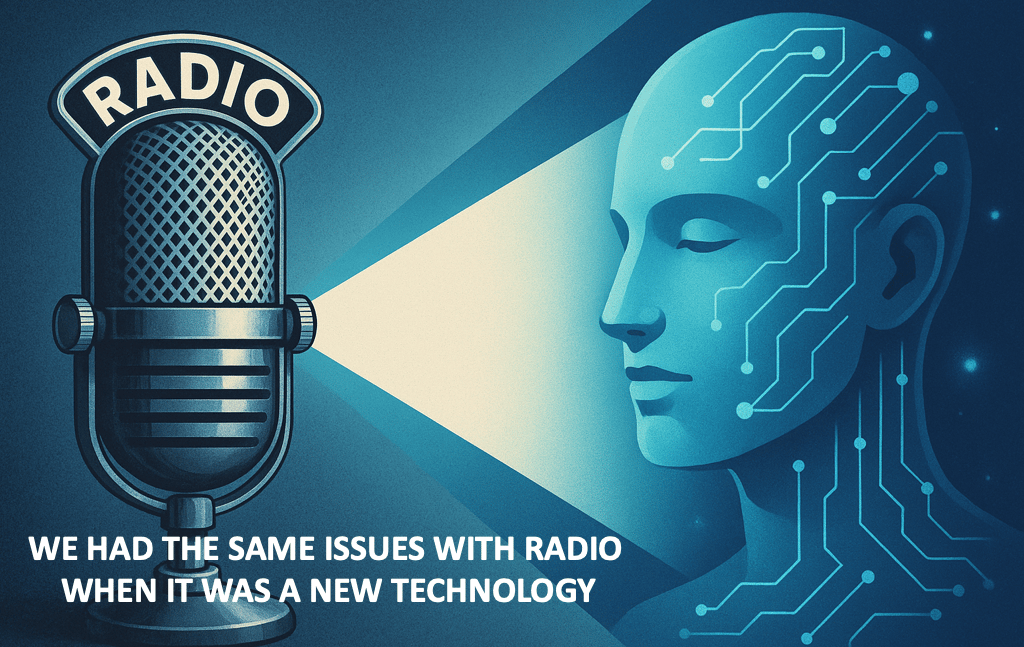
AI - Radio: We had the same issues when radio was a new technology - we fixed them then - we can fix them now.
11/10/202516 min read
When New Technology Meets Millions: Why We Need AI Regulation (And What Radio Can Teach Us)
By Paul Zurav
Bottom Line Up Front
That viral quote about Transportation Secretary Sean Duffy telling pilots to ignore air traffic controllers and "go with their gut feelings"? Complete fabrication. Never happened. Someone grabbed a screenshot from an unrelated interview, slapped fake text on it, and thousands of people—smart, careful people—believed it and spread it.
Sound familiar? It should. Same playbook as 1938, when Orson Welles convinced a chunk of America that Martians were landing in New Jersey.
We've watched this movie before. When radio exploded in the 1920s, it was chaos—signals jamming each other, nobody in charge, the whole thing threatening to collapse. Congress stepped in with the Radio Act of 1927. Not to censor content, but to organize the chaos so the technology could actually work.
Here's what most people miss: AI deepfakes aren't radio. The old playbook doesn't transfer directly. But the core insight does: When technology gives private actors the power to influence millions, some baseline framework protecting the public interest isn't optional—it's necessary for the system to function.
We don't need a new Fairness Doctrine for AI. We need truth infrastructure. Not the government deciding what's true, but requiring mechanisms so YOU can tell authentic from synthetic. Like nutrition labels, not food prohibition.
This isn't about censorship. It's about building the guardrails that let democracy function when anyone can make anyone appear to say anything.
The question isn't whether to act. It's whether we'll act before the damage becomes irreversible.
Part I: The Fake Duffy Quote—A Perfect Case Study
Let's break down how this con worked, because understanding the mechanics is step one.
The claim: Sean Duffy said pilots should "suck it up and go with their gut feelings" instead of depending on air traffic controllers.
The reality: Complete bullshit. Lead Stories, MEAWW, and other fact-checkers confirmed—no video, no documentation, no credible reporting. Nothing.
What actually happened: Someone took a screenshot from an August 2025 Fox Business interview where Duffy was talking about moon bases (yes, moon bases), added fabricated text, hit send. The internet did the rest.
Why it worked—four factors that repeat across nearly a century:
Medium manipulation: Welles used radio's news bulletin format to hijack trust. The fake Duffy quote used authentic-looking social media screenshots. Both exploited faith in the format itself.
Context stripping: Radio listeners tuning in late missed the "this is fiction" disclaimer. Social media users encountering the screenshot mid-feed had no way to verify. Same vulnerability, ninety years apart.
Emotional resonance: 1938 had Hitler on the march—people were primed to believe invasion reports. 2025 has a government shutdown threatening air travel during Thanksgiving. Both stories tapped existing anxieties.
Viral before verified: Both achieved mass distribution before corrections could catch up. The lie got its boots on while truth was still looking for its shoes.
The pattern is remarkably consistent: New technology + mass distribution + human psychology = predictable manipulation.
Part II: Radio's Evolution—The Historical Parallel That Actually Matters
Act One: 1912—Nobody's Really In Charge
The first federal radio regulation came after the Titanic. Makes sense—1,500 people die partly because ship radios weren't properly managed, Congress notices.
The Radio Act of 1912 meant well:
Licensed radio operators
Required 24/7 ship radio operation with backup power
Set minimum transmission ranges
The problem: It gave the Department of Commerce nominal authority but zero enforcement teeth. They couldn't deny licenses, assign frequencies, or control transmission power.
Worked fine for ship-to-shore communication. When commercial broadcasting exploded? Disaster.
Act Two: The 1920s—When Radio Ate Itself
By mid-1920s, you had 732 broadcasting stations fighting for the same limited airwaves.
The result:
Signal interference made broadcasts unintelligible—tune in for your show, get three stations talking over each other
"Wave jumping" went epidemic—stations deliberately broadcasting on others' frequencies
Two court rulings (1921, 1926) confirmed Commerce had zero legal authority to do anything about it
Radio was threatening to implode. The technology couldn't fulfill its promise if nobody could actually hear anything clearly.
Act Three: 1927—The Adults Show Up
Congress said "enough." President Coolidge signed the Radio Act of 1927 on February 23rd—entirely new law replacing the useless 1912 version.
What they created:
Federal Radio Commission (FRC): New independent body with real power. Five commissioners, actual authority. (Evolved into the FCC in 1934, still running the show today.)
"Public interest, convenience, or necessity" standard: The foundation that matters. The airwaves belong to everyone. Get a license to use them, you're holding them in trust for the public good—not just your private profit.
Real licensing power: Could grant, deny, revoke licenses. Finally, someone could say "no."
Frequency allocation: Organized who broadcasts where. Ended the chaos.
Equal time for political candidates: Section 18 said give one candidate airtime, you give the opponent equal time. First attempt at political fairness.
The revolutionary concept: Broadcasters as public trustees. The FRC explained: "The station itself must be operated as if owned by the public... Manage this station in our interest."
Not "maximize profit." Not "broadcast whatever." Manage this in OUR interest.
Act Four: 1949—Enter the Fairness Doctrine
The "public interest" standard kept evolving. In 1949, the FCC established the Fairness Doctrine—broadcasters had to cover controversial public issues AND present contrasting viewpoints.
Core requirements:
Actually cover controversial issues (don't just ignore uncomfortable topics)
Give airtime to different perspectives when you do
1969 Supreme Court validation: Red Lion Broadcasting v. FCC upheld it. Logic: Limited broadcast frequencies + monopoly control over those frequencies = government interest in ensuring diverse viewpoints reach the public.
1987: Reagan kills it: FCC concluded it had a "chilling effect"—broadcasters avoided controversial topics entirely rather than risk FCC complaints. Plus cable/satellite meant scarcity wasn't really a thing anymore.
Congress tried to save it. Reagan vetoed. Dead.
The critical lesson: Even well-intentioned regulation can backfire if it makes people too afraid to speak. Remember this. It matters for AI.
Part III: War of the Worlds—When One Show Broke America's Brain
October 30, 1938: The Night That Changed Everything
Orson Welles was 23 and already brilliant. His Mercury Theatre on the Air adapted H.G. Wells' "War of the Worlds" for Halloween eve. But instead of just reading the story, they made it sound like real breaking news.
You're home Sunday night. Music program playing. Sudden interruption—strange explosions on Mars. More music. Another interruption—Martians landed in Grover's Mill, New Jersey. Reporter on scene, voice rising in panic, describes massive metal cylinders opening, creatures emerging. Screaming. Silence.
Production elements that sold it:
Realistic news bulletin format interrupting regular programming
Actor Frank Readick deliberately copying Hindenburg disaster coverage—that raw, unscripted terror
Progressive escalation: weird explosions → widespread devastation → New York City under attack
Expert voices: professors, military officials, all the authority figures you'd expect
Limited disclaimers: Opening announcement, mid-broadcast break, closing statement. That's it.
The tuning-in-late problem: Turn on your radio after the opening disclaimer, you hear only simulated news reports. No context. No "this is fiction" warning. Just increasingly terrifying updates about an alien invasion that sounds completely real.
And it WAS completely real to them. They had no reason to think otherwise.
The Panic: Real or Exaggerated?
Modern historians say newspapers exaggerated the "mass panic"—they were losing ad revenue to radio and had every reason to make radio look dangerous.
But something definitely happened:
12 million listeners that night
Roughly 1 million believed it was real initially
Thousands of calls flooded police, newspapers, CBS
Some fled homes, some armed themselves
Churches filled with people seeking refuge
Dominated headlines for days
Why it worked:
Radio was new (1938): People still learning to evaluate what they heard
Pre-WWII anxiety: Hitler already on the march—invasion fears were primed
Production sophistication: Unprecedented realism for the medium
Format confusion: Fake newscast format was unfamiliar
Partial listening: Tune in late, miss all context
What the FCC Did (And Didn't Do)
The FCC investigated immediately. They focused on what they called "simulated news items"—using the format of news to present fiction.
Their December 1938 conclusion:
No laws broken
CBS agreed to avoid making fiction sound like breaking news
The FCC emphasized media literacy as the crucial defense
No punitive action taken, but industry practices shifted
Here's the critical part: The FCC explicitly stated it would not become "arbiter of truth in journalism."
They didn't say "CBS can never do drama again." Didn't create a list of approved formats. Didn't censor content.
They said: "This is a problem we solve through education and industry responsibility, not government censorship."
That principle still shapes broadcast regulation today. And it damn well better shape how we think about AI regulation.
Part IV: Seven Patterns That Repeat
1. NEW TECHNOLOGY, MASS INFLUENCE, NOBODY PREPARED
Radio 1920s: Suddenly in millions of homes. First true mass media—everyone hearing the same thing simultaneously. No filter between broadcaster and audience.
AI Deepfakes 2020s: Tools accessible to anyone. Social media enables instant viral distribution. Sophisticated enough to fool humans. No technical barriers.
Same pattern: Powerful new reach tool. Nobody's figured out the rules yet.
2. CHAOS BEFORE ORGANIZATION
Radio: Signals jamming each other made the system unusable. No standards, no coordination. Market forces alone couldn't solve it—someone HAD to organize who broadcasts where.
AI: Patchwork of state laws creating confusion. No authentication standards. Platform policies vary wildly. Section 230 (1996 law saying platforms aren't responsible for user content) complicates accountability.
We're IN the chaos phase. Question: organize it or let it collapse?
3. "PUBLIC INTEREST" AS ORGANIZING PRINCIPLE
Radio logic: Airwaves are public resource. Limited number can use them. If you get to use them, you hold them in trust for public good. License is privilege, not right.
Potential AI framework: Digital information space is public commons. Platforms amplifying content have responsibilities. AI companies as stewards of truth/falsehood line. Right to amplify comes with duty to authenticate.
Core concept translates: Private actors using public resources owe something to the public.
4. SCARCITY VS. ABUNDANCE (Where It Gets Tricky)
Radio's scarcity: Only so many frequencies physically available. Government had to allocate. This scarcity justified content regulation (Supreme Court agreed, Red Lion).
AI's abundance: Anyone can create deepfakes. Infinite digital distribution. Traditional scarcity arguments don't apply. Courts rejected applying radio-style regulation to internet (Reno v. ACLU, 1997).
Critical insight: Radio regulation worked because of physical scarcity. Internet has no such scarcity—you can't copy-paste the old rules.
BUT—while distribution channels are infinite, attention and trust are scarce resources. Maybe that's the scarcity we need to protect.
5. DISCLOSURE OVER PROHIBITION
Radio's equal time: Political candidates get equal airtime. Stations announce sponsors. Transparency about who's speaking.
Current deepfake proposals:
25 states considering labeling for AI political content
NO FAKES Act: disclosure of AI replicas required
COPIED Act: watermarking and provenance standards
DEFIANCE Act: civil liability for non-consensual intimate images (NCII—deepfake porn, revenge porn)
Pattern: Require disclosure of what's synthetic rather than banning synthesis.
6. THE "CHILLING EFFECT" (Why We Must Be Careful)
Fairness Doctrine criticism: Broadcasters avoided controversial topics entirely. FCC complaint fear stifled speech. Compliance costs were burdensome.
Current AI concerns: Over-regulation kills innovation. Detection systems make mistakes—false positives chill legitimate speech. Platform liability drives over-removal. First Amendment protects SOME synthetic content (satire, commentary, art).
Lesson: Well-intentioned regulation can backfire if it makes people too afraid to speak. Balance protection against chilling effects.
7. MEDIA LITERACY AS COMPLEMENTARY DEFENSE
1938 lesson: FCC concluded education crucial. Understanding medium's capabilities matters. Critical thinking about sources.
2025 imperative: Detection tools for deepfakes. Public education on AI capabilities. "Verify before sharing" as cultural norm. Understanding authenticity markers.
Regulation alone never solves it. You need an informed public that thinks critically.
Part V: Why Radio's Framework Doesn't Directly Transfer (But The Principles Do)
The Five Critical Differences
1. No Central Licensing Authority
Radio: FCC issues licenses, can revoke
AI/Internet: No bottleneck, no licensing regime possible
2. Scarcity vs. Abundance
Radio: Limited spectrum justified content control
AI: Courts require higher bar for internet restrictions (Reno v. ACLU)
3. Who's The "Speaker"?
Radio: Broadcaster is speaker
AI: The company providing tools? Person inputting prompts? Person distributing output? Platform hosting content?
4. Section 230 Complications
Radio: Licensees responsible for all content aired
Internet: Platforms immune from liability for user content (mostly)
5. Global vs. National
Radio: Nation-state could regulate domestic spectrum
AI: Global technology, cross-border distribution, jurisdictional nightmare
What CAN Transfer: Six Principles
1. Public Interest Standard for Amplification Algorithms
Don't regulate creation (protected speech). Regulate amplification (commercial activity). Require transparency for recommendation algorithms. Set standards for known deepfake distribution.
2. Disclosure Over Prohibition
Mandatory disclosure: "This is AI-generated." Provenance tracking: watermarking, metadata. Authentication tools: verification systems. Platform policies: clear rules on synthetic media.
This addresses information asymmetry without direct content regulation.
3. Media Literacy as Infrastructure
Public education on deepfake detection. Critical evaluation skills. Verification before sharing. Understanding AI capabilities and limitations.
4. Targeted Regulation of Specific Harms
Non-consensual intimate images (clearly harmful, narrowly tailored)
Election fraud (deceptive material about voting process)
Commercial fraud (FTC authority already exists)
Defamation (existing tort law applies)
5. International Coordination
Standards for content authentication. Cross-border enforcement cooperation. Shared detection technologies. Common definitions and thresholds.
6. Industry Self-Regulation with Oversight
Platforms develop specific policies. Regular transparency reports. Independent auditing. Government backstop for non-compliance.
Part VI: The Fundamental Question—Regulating Tools vs. Regulating Use
This is where the analogy breaks most profoundly:
Radio regulation: Regulated the MEDIUM itself—spectrum allocation, licensing, content.
AI regulation: Must focus on USES—fraud, harassment, defamation, election interference.
AI is a TOOL (like printing press or camera), not a MEDIUM (like radio or TV). First Amendment jurisprudence treats these very differently.
You can regulate broadcasters because they control access to limited frequencies. You can't regulate AI tools the same way because everyone has access and there's no scarcity.
Part VII: A Proposed Framework
Drawing from radio's evolution, here's a tiered approach:
Tier 1: Prohibited Uses (Narrow)
Non-consensual intimate images (NCII—deepfake porn, revenge porn, sextortion)
Child sexual abuse material
Material fraud
Deceptive election process information (time/place/manner of voting)
Tier 2: Mandatory Disclosure (Medium)
AI-generated political content
Commercial advertising using synthetic personas
News/journalism using AI imagery
Any content claiming to be authentic that isn't
Tier 3: Platform Responsibilities (Broad)
Algorithmic amplification transparency
Tools for users to verify authenticity
Clear policies on synthetic media
Response protocols for reported deepfakes
No amplification of known deepfakes in sensitive contexts (elections, emergencies)
Tier 4: Enablement Infrastructure (Foundational)
Technical standards for watermarking/provenance
Public education campaigns
Detection tool development
Research funding
Independent oversight body
Part VIII: The Case for Regulation—Truth Infrastructure
The strongest argument for AI regulation draws not on content control but on INFRASTRUCTURE:
Radio Act logic: Government organized spectrum so communication could occur efficiently.
AI framework: Government should organize TRUTH INFRASTRUCTURE so authentic communication can be distinguished from synthetic.
This isn't regulating speech. It's regulating the conditions that make meaningful speech possible.
Key distinction:
Government doesn't determine truth (the "arbiter of truth" problem)
Government requires MECHANISMS for users to determine truth themselves
Like nutrition labels, not food prohibition
Part IX: What's At Stake
Democracy
Elections depend on voters distinguishing real from fake. Public trust erodes when anything can be faked. Discourse breaks down when common reality disappears.
Individual Rights
Deepfake victims have limited recourse. Non-consensual intimate images cause severe harm. Identity theft and reputation destruction accelerate.
Market Function
Fraud becomes easier and harder to prove. Commercial relationships depend on authenticity. Trust erosion increases transaction costs everywhere.
Social Cohesion
Shared reality is prerequisite for collective action. When everything's suspect, nothing's trusted. Cynicism and disengagement follow.
Part X: The Urgency of Now
The Radio Act came AFTER years of chaos proved the market alone couldn't solve coordination problems. The Fairness Doctrine emerged AFTER the medium's power to shape opinion became clear. War of the Worlds happened BEFORE broadcasters fully understood their responsibility.
With AI deepfakes, we have foresight. We know the technology exists. We've seen the harms—celebrity deepfakes, election misinformation, financial fraud. We're experiencing the fake Duffy quote and thousands like it.
The question isn't whether to regulate, but HOW to regulate in ways that:
Protect First Amendment rights to create and share content
Prevent specific, demonstrable harms like fraud and harassment
Preserve innovation in beneficial AI applications
Build infrastructure for authentication and verification
Educate the public on critical evaluation
Maintain proportionality between restrictions and risks
The Radio Act's core insight remains valid: When technology gives private actors power to influence millions, some baseline framework protecting public interest is necessary. The challenge is adapting that principle to a technology where EVERYONE can be a broadcaster, and where NOTHING needs to be true.
Recommendations
For Policymakers:
Focus on disclosure and authentication infrastructure over content prohibition
Address specific harms (NCII, fraud) with narrow, tailored rules
Support technical standards development (watermarking, provenance)
Fund public education and media literacy programs
Require platform transparency on amplification algorithms
Create independent oversight body (modern FRC equivalent)
For Platforms:
Implement robust authentication systems
Provide users with verification tools
Clear policies against harmful deepfakes
Transparency reports on synthetic media
Collaborate on technical standards
Quick response mechanisms for victims
For Media Organizations:
Verification protocols before publication
Clear labeling of AI-generated content
Education of journalists on detection
Ethical guidelines for AI use
Fact-checking collaborations
For Individuals:
Verify before sharing
Check source authenticity
Look for disclosure labels
Use available verification tools
Report suspected deepfakes
Support quality journalism
The War of the Worlds Lesson for Today
Orson Welles proved that even with disclaimers, sufficiently realistic presentation using trusted medium causes mass confusion. The FCC's response—emphasizing media literacy over censorship—was wise.
Today's deepfakes are far more sophisticated than 1938's radio drama. They don't need us to tune in late. They come to us in social media feeds, pre-stripped of context, designed to bypass critical faculties.
The lesson isn't that we need a new Fairness Doctrine for AI. It's that we need the same basic framework radio regulation eventually achieved: A foundation ensuring technology serves public interest, with targeted rules against specific harms, and robust public capacity to evaluate content critically.
Radio taught us that new technologies influencing millions require regulatory framework. The challenge is building that framework without recreating radio regulation's flaws—vague standards, censorship potential, innovation stifling.
We need regulation that is:
Narrow in prohibition
Broad in disclosure
Robust in infrastructure
Proportional to harms
Adaptive to evolution
Rights-protective in implementation
The alternative—the digital equivalent of 1920s radio chaos—is already here. The fake Duffy quote is one data point in an ocean of synthetic content. Without action, we face not just individual confusion incidents, but wholesale erosion of shared reality itself.
That's the case for regulation. The question is whether we'll act before the damage becomes irreversible.
Sources and Bibliography
Radio Regulation to AI Deepfakes Research
(Wikipedia sources excluded per request)
Historical Radio Regulation Sources
Radio Act of 1927 and Federal Radio Commission
1. Anniversary of the Radio Act of 1927, The Beginning of Broadcast Regulation | In Custodia Legis
Library of Congress analysis of the Act's significance
https://blogs.loc.gov/law/2016/02/anniversary-of-the-radio-act-of-1927-the-beginning-of-broadcast-regulation/
2. Radio Act | United States [1927] | Britannica
Encyclopedia entry on the Radio Act
https://www.britannica.com/topic/Radio-Act-United-States-1927
3. February 1927 - ITS (Institute for Telecommunication Sciences)
Technical history of radio regulation
https://its.ntia.gov/this-month-in-its-history/february-1927
4. Radio Act of 1927 | Research Starters | EBSCO Research
Academic analysis of the Act's impact
https://www.ebsco.com/research-starters/history/radio-act-1927
5. Radio Act of 1927 (1927) | The First Amendment Encyclopedia
Constitutional analysis of the Act
https://firstamendment.mtsu.edu/article/radio-act-of-1927/
6. Radio Act | Encyclopedia.com
Historical context and development
https://www.encyclopedia.com/history/encyclopedias-almanacs-transcripts-and-maps/radio-act
7. Radio Act of 1927 [established the Federal Radio Commission] | Federal Communications Commission
Official FCC documentation
https://www.fcc.gov/document/radio-act-1927-established-federal-radio-commission
8. Federal Radio Commission | History & Importance | Study.com
Educational resource on FRC history
https://study.com/academy/lesson/federal-radio-commission-history-function-frc.html
Fairness Doctrine
9. Fairness Doctrine | Ronald Reagan Presidential Library
Reagan administration's role in repeal
https://www.reaganlibrary.gov/archives/topic-guide/fairness-doctrine
10. Rosel H. Hyde Article on the FCC Fairness Doctrine
Legal analysis of the Doctrine
https://lawreview.syr.edu/about/history/rosel-h-hyde-article-on-the-fcc-fairness-doctrine/
11. Fairness doctrine | History, Provisions, Repeal, & Facts | Britannica
Encyclopedia entry on the Doctrine
https://www.britannica.com/topic/Fairness-Doctrine
12. Fairness Doctrine | The First Amendment Encyclopedia
Constitutional analysis
https://firstamendment.mtsu.edu/article/fairness-doctrine/
13. The History and Possible Revival of the Fairness Doctrine - Imprimis
Hillsdale College analysis
https://imprimis.hillsdale.edu/the-history-and-possible-revival-of-the-fairness-doctrine/
14. Why The Fairness Doctrine Is Anything But Fair | The Heritage Foundation
Conservative perspective on the Doctrine
https://www.heritage.org/government-regulation/report/why-the-fairness-doctrine-anything-fair
15. The Fairness Doctrine: A Solution in Search of a Problem
Academic legal analysis
https://www.repository.law.indiana.edu/cgi/viewcontent.cgi?article=1033&context=fclj
Public Interest Standard
16. The Public Interest Standard in Television Broadcasting
Government analysis of public interest evolution
https://govinfo.library.unt.edu/piac/novmtg/pubint.htm
17. Revisiting the broadcast public interest standard in communications law and regulation | Brookings
Modern analysis by Stuart Brotman
https://www.brookings.edu/articles/revisiting-the-broadcast-public-interest-standard-in-communications-law-and-regulation/
18. Public Interest Standard - Center for Media Engagement
University of Texas roundtable discussion
https://mediaengagement.org/public-interest-standard/
19. 90 years later, the broadcast public interest standard remains ill-defined | Brookings
Contemporary critique
https://www.brookings.edu/articles/90-years-later-the-broadcast-public-interest-standard-remains-ill-defined/
20. The Communications Act of 1934 | Bureau of Justice Assistance
Government documentation
https://bja.ojp.gov/program/it/privacy-civil-liberties/authorities/statutes/1288
21. 'The Public Interest Standard in Television Broadcasting' - Current
Gore Commission analysis
https://current.org/1998/12/the-public-interest-standard-in-television-broadcasting/
22. Krasnow Paper on Public Interest Standard (10-22-97)
Academic analysis
https://govinfo.library.unt.edu/piac/octmtg/Krasnow.htm
23. The Four Eras of FCC Public Interest Regulation - Lili Levi
Law review article
https://administrativelawreview.org/wp-content/uploads/sites/2/2014/04/The-Four-Eras-of-FCC-Public-Interest-Regulation.pdf
24. Federal Communications Commission | The First Amendment Encyclopedia
FCC history and First Amendment issues
https://www.mtsu.edu/first-amendment/article/804/federal-communications-commission
25. The Four Eras of FCC Public Interest Regulation (Miami Law Review)
Academic legal analysis
https://repository.law.miami.edu/cgi/viewcontent.cgi?article=1379&context=fac_articles
War of the Worlds Sources
26. Orson Welles' 'War of the Worlds' radio play is broadcast | History.com
Historical overview
https://www.history.com/this-day-in-history/october-30/welles-scares-nation
27. The Fake News of Orson Welles: The War of the Worlds at 80 | National Endowment for the Humanities
80th anniversary analysis
https://www.neh.gov/article/fake-news-orson-welles-war-worlds-80
28. The Infamous 'War of the Worlds' Radio Broadcast Was a Magnificent Fluke | Smithsonian
Behind-the-scenes production history
https://www.smithsonianmag.com/history/infamous-war-worlds-radio-broadcast-was-magnificent-fluke-180955180/
29. Analysis: On The War of the Worlds Radio Broadcast | Research Starters | EBSCO
Academic analysis
https://www.ebsco.com/research-starters/military-history-and-science/analysis-war-worlds-radio-broadcast
30. 75 Years Ago, 'War Of The Worlds' Started A Panic. Or Did It? | NPR
Analysis of whether panic was exaggerated
https://www.npr.org/sections/thetwo-way/2013/10/30/241797346/75-years-ago-war-of-the-worlds-started-a-panic-or-did-it
31. It's been 80 years since Orson Welles' 'War of the Worlds' radio broadcast | ABC News
Anniversary coverage
https://abcnews.go.com/US/80-years-orson-welles-war-worlds-radio-broadcast/story?id=58826359
32. Orson Welles' 'War of the Worlds' Broadcast 1938 and Ominous Echoes | Hollywood Reporter
Media analysis connecting to modern disinformation
https://www.hollywoodreporter.com/business/digital/orson-welles-war-of-the-worlds-broadcast-its-ominous-echoes-for-a-fractured-media-1235250796/
33. Watch War of the Worlds | American Experience | Official Site | PBS
Documentary analysis
https://www.pbs.org/wgbh/americanexperience/films/worlds/
34. The History of The War of The Worlds Radio Broadcast from 1938 | Lunatics Project
Detailed historical account
https://www.lunaticsproject.com/post/the-history-of-the-war-of-the-worlds-radio-broadcast-from-1938
Fake Duffy Quote Fact-Checks
35. Fact Check: Did Transportation Secretary Sean Duffy say pilots don't need air traffic controllers? | MEAWW
Fact-check confirming quote is false
https://news.meaww.com/fact-check-did-transportation-secretary-sean-duffy-say-pilots-dont-need-air-traffic-controllers
36. Fact Check: Transportation Secretary Sean Duffy Did NOT Say Pilots Don't Need Air Traffic Controllers | Lead Stories
Comprehensive fact-check
https://leadstories.com/hoax-alert/2025/11/fact-check-sean-duffy-did-not-say-pilots-dont-need-atc.html
37. Fact Check: Transportation Secretary Sean Duffy Did NOT Say Pilots Don't Need Air Traffic Controllers | Yahoo News
Fact-check confirmation
https://www.yahoo.com/news/articles/fact-check-transportation-secretary-sean-073255867.html
AI Deepfakes Legislation and Regulation
Federal Proposals
38. Dean, Salazar Introduce Bill to Protect Americans from AI Deepfakes | Congresswoman Madeleine Dean
NO FAKES Act announcement
https://dean.house.gov/2024/9/dean-salazar-introduce-bill-to-protect-americans-from-ai-deepfakes
39. Deepfake Regulation Overview: All About AI and Deepfake Laws | Reality Defender
Comprehensive overview of deepfake regulations
https://www.realitydefender.com/insights/the-state-of-deepfake-regulations-in-2025-what-businesses-need-to-know
40. Update on 2025 State Legislation to Regulate Election Deepfakes - R Street Institute
Analysis of state legislative trends
https://www.rstreet.org/commentary/update-on-2025-state-legislation-to-regulate-election-deepfakes/
41. The US has plans to tackle AI-generated deepfakes | World Economic Forum
International perspective
https://www.weforum.org/stories/2024/02/ai-deepfakes-legislation-trust/
42. Deepfakes Dominate Early Attempts to Regulate AI | Governing Magazine
State-level regulation analysis
https://www.governing.com/policy/deepfakes-dominate-early-attempts-to-regulate-ai
43. Evaluation of Deepfakes Proposals in Congress - Future of Life Institute
Comparative analysis of federal bills
https://futureoflife.org/ai-policy/evaluation-of-deepfakes-proposals-in-congress/
44. Deepfake Regulations: AI and Deepfake Laws of 2025 | Regula Forensics
Global regulatory overview
https://regulaforensics.com/blog/deepfake-regulations/
45. Cantwell, Blackburn, Heinrich Introduce Legislation | Senate Commerce Committee
COPIED Act announcement
https://www.commerce.senate.gov/2024/7/cantwell-blackburn-heinrich-introduce-legislation-to-combat-ai-deepfakes-put-journalists-artists-songwriters-back-in-control-of-their-content
46. U.S. Legislative Trends in AI-Generated Content: 2024 and Beyond | Future of Privacy Forum
Policy analysis
https://fpf.org/blog/u-s-legislative-trends-in-ai-generated-content-2024-and-beyond/
47. More and More States Are Enacting Laws Addressing AI Deepfakes | MultiState
State legislative tracking
https://www.multistate.us/insider/2024/4/5/more-and-more-states-are-enacting-laws-addressing-ai-deepfakes
AI Misinformation and Social Media Regulation
48. Regulation of Misinformation in the Digital Age | Critical Debates
Academic analysis of First Amendment issues
https://criticaldebateshsgj.scholasticahq.com/article/137214-regulation-of-misinformation-in-the-digital-age-first-amendment-rights-and-government-s-role-in-social-media
49. AI-driven disinformation: policy recommendations | PMC
Public health/policy journal article
https://pmc.ncbi.nlm.nih.gov/articles/PMC12351547/
50. Freedom of Speech and Regulation of Fake News | American Journal of Comparative Law
Legal analysis
https://academic.oup.com/ajcl/article/70/Supplement_1/i278/6597032
51. Laws for AI Are Double-Edged Sword in the Disinformation Battle | Bloomberg Law
Legal analysis of AI regulation challenges
https://news.bloomberglaw.com/us-law-week/laws-for-ai-are-double-edged-sword-in-the-disinformation-battle
52. Why Can't We Regulate Social Media Like Previous Media? | AI Policy Substack
Comparative analysis of media regulation
https://aipolicy.substack.com/p/socialmedia3
53. Responding to Fake news through regulation and automation - Carter-Ruck
Legal firm analysis
https://www.carter-ruck.com/insight/fakes-news-authentic-views/responding-to-fake-news-through-regulation-and-automation/
54. How to regulate misinformation | Royal Society
UK scientific perspective
https://royalsociety.org/blog/2022/01/how-to-regulate-misinformation/
55. Online disinformation: UNESCO unveils action plan | UNESCO
International governance framework
https://www.unesco.org/en/articles/online-disinformation-unesco-unveils-action-plan-regulate-social-media-platforms
56. Holding platforms accountable in the fight against misinformation | SAGE Journals
Academic comparative analysis
https://journals.sagepub.com/doi/10.1177/17480485251348550
57. AI Regulation and Public Service Media | EBU
European Broadcasting Union perspective
https://www.ebu.ch/guides/loginonly/report/ai-regulation-and-its-importance-for-public-service-media-a-look-ahead
Government Shutdown Context (for Duffy Quote Background)
58. Transportation Secretary Sean Duffy on flight reductions | ABC News
Context for government shutdown and air traffic issues
https://abcnews.go.com/Politics/video/transportation-secretary-sean-duffy-flight-reductions-thanksgiving-travel-127313822
59. Air Traffic Controllers Start Resigning as Shutdown Bites | The Daily Beast
Context for actual air traffic control crisis
https://www.thedailybeast.com/air-traffic-controllers-start-resigning-as-shutdown-bites/
60. Transportation Secretary Duffy says flight data was 'concerning' | CBS News
Actual Sean Duffy statements about air traffic
https://www.cbsnews.com/news/transportation-secretary-sean-duffy-flight-cancellations-government-shutdown/
61. Air traffic staffing shortages disrupt thousands of flights | CNBC
Context for the crisis
https://www.cnbc.com/2025/11/08/government-shutdown-flight-cancelations-faa.html
Research Methodology Note
This research was conducted through systematic web searches using authoritative sources including:
· Academic journals and law reviews
· Government documents and official websites (FCC, Library of Congress, Congressional records)
· Fact-checking organizations (Lead Stories, MEAWW)
· Major news outlets (NPR, Smithsonian, ABC News, CBS News, CNBC, History.com, Hollywood Reporter)
· Think tanks and research organizations (Brookings, Heritage Foundation, R Street Institute, Future of Life Institute)
· International organizations (UNESCO, World Economic Forum)
· Legal and regulatory analysis sources
· Educational and research institutions (EBSCO, Study.com, PBS)
All sources were accessed and verified between November 9-10, 2025.
Home | My Books| About Paul Zurav | Taking a Closer Look | Privacy Policy | Contact
Copyright: © 2026 CTEK LLC / Paul Zurav