
We are the Smart Ones?
A closer look at the myth of human intelligence in an age of collapse and codeBlog post description.
10/31/202514 min read
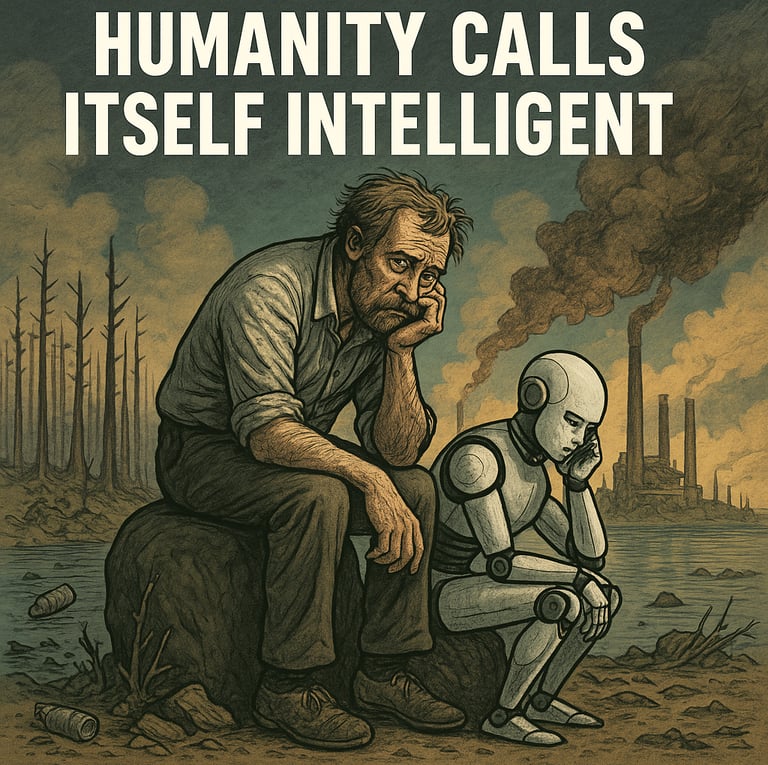
We Are the Intelligent Species??
I. The Opening Irony
We love to call ourselves the intelligent species. It’s a flattering phrase—our favorite mirror. We built cities visible from orbit, machines that out-calculate our brains, and networks that let anyone broadcast a thought before they’ve had one. Then we used those same miracles to dismantle the very systems keeping us alive.
If intelligence means foresight, we’ve mistaken cleverness for wisdom. Ants coordinate megacities underground without wrecking their ecosystem. Whales navigate oceans without extracting a drop of oil. Trees communicate nutrients across entire forests without ever forming a committee. Humanity, meanwhile, engineered a global economy that burns the lungs of the planet and calls it success.¹
We burn fossilized sunlight to power convenience. We bury food while millions starve. We celebrate “innovation” that accelerates consumption, then launch conferences to discuss why we feel so empty. The planet isn’t asking whether we can build faster; it’s wondering when we’ll remember how to stop.
Our intelligence expresses itself in contradictions:
We invent antibiotics and pesticide resistance in the same century.
We teach critical thinking, then reward obedience.
We idolize efficiency, even when it makes us fragile.
The irony is cosmic. We measure progress in GDP—a statistic that counts pollution cleanup as economic growth and the extinction of a species as neutral. We are brilliant at naming problems and allergic to solving them.
No other creature has invented an industry to manage its own decline. Only humans could turn collapse into a business model and sell hope by subscription.
II. The Definition of Madness
Einstein supposedly called insanity doing the same thing over and over while expecting different results. If that’s true, the modern world is a master class in repetition. Every year breaks a heat record; every season, a disaster; every summit, the same pledges followed by the same betrayals.
We have the data. We’ve had it for decades. The Intergovernmental Panel on Climate Change warned us before most people owned a computer.² Yet emissions rise, deforestation accelerates, and politicians still debate the existence of the fire while standing in the smoke.
Consider our reflexes: when drought strikes, we pump deeper wells; when fish disappear, we build bigger nets; when traffic clogs, we pave more lanes. Each “solution” magnifies the original wound. We call it progress because stopping feels unthinkable.
Economists label planetary destruction a market failure. Psychologists might call it addiction. The pattern is textbook: denial, bargaining, relapse. We insist the system can’t change because it works—as if working means enriching a few while cooking the rest.
We’re addicted to momentum. The fossil-fuel economy isn’t just an energy system; it’s a psychological one. It rewards short attention spans, quarterly profits, and the illusion that someone else will clean up the mess. Governments subsidize the damage—over $7 trillion a year—then hold hearings about budget deficits.³
And when consequences appear, we rename them. Floods become “once-in-a-century events” that happen twice a decade. Fires become “seasonal variability.” The press dutifully compares each catastrophe to “the cost of doing business.” The business, of course, is survival.
Technology magnifies the madness. Algorithms trained on outrage keep us too distracted to notice structural decay. Every crisis competes for attention until nothing holds it. We scroll past famine the same way we scroll past breakfast photos. The feed refreshes; empathy resets.
Our ancestors feared gods of thunder and drought; we’ve replaced them with markets and influencers, equally moody and capricious. We don’t pray for rain anymore—we pray the Wi-Fi doesn’t drop during the storm.
This isn’t progress. It’s a loop.
III. The Planetary Diagnosis
If the planet were a patient, the charts would be catastrophic. Temperature: rising. Lungs: inflamed. Circulation: clogged. Immune system: collapsing. The prognosis? Terminal—unless the patient changes behavior immediately.
Symptom 1 – Fever.
Global temperatures have climbed about 1.2 °C (2.2 °F) above pre-industrial levels, but the averages hide the spikes: 40 °C (104 °F) in London, 50 °C (122 °F) in India, forests in Canada burning so hot they create their own weather.⁴ Fever this persistent damages every organ.
Symptom 2 – Respiratory Failure.
Forests—the planet’s lungs—are losing capacity. The Amazon now emits more carbon than it stores.⁵ Logging, fire, and drought have converted it from buffer to source. The patient is literally exhaling death.
Symptom 3 – Circulatory Collapse.
Oceans absorb most of the heat and a third of our CO₂. The result: acidification. Shellfish can’t form shells; coral reefs—the capillaries of marine life—bleach and crumble.⁶ The Great Barrier Reef alone has lost half its coral since 1995. What were once sprawling underwater metropolises have become skeletal neighborhoods glowing ghost-white under stress.
Symptom 4 – Toxic Buildup.
Plastic now infiltrates every organ system of Earth. Microplastics fall with snow in the Arctic and circulate in human bloodstreams. The Pacific Garbage Patch—twice the size of Texas—is only the visible rash; the deeper infection floats invisibly through every current.⁷
Symptom 5 – Organ Failure.
Species extinction proceeds at 100 to 1000 times the natural rate.⁸ Each lost species erases a solution evolution spent millions of years testing. Yet the corporate world logs biodiversity losses the way accountants log “non-recurring expenses.”
Symptom 6 – Cognitive Dissonance.
Despite the diagnosis, humanity argues over the bill. “Too expensive,” say the same interests that pocket the subsidies.⁹ We stage summits where delegates debate comma placement in communiqués while glaciers break off outside the window.
Symptom 7 – Denial as Anesthetic.
Hope becomes a marketing strategy. “Green growth” promises that we can have it all: endless consumption powered by slightly cleaner energy. Carbon offsets sell absolution. Corporations hire storytellers to narrate the apocalypse as an opportunity.
Symptom 8 – Moral Paralysis.
Knowing and acting are different organs, and ours no longer coordinate. We cheer documentaries about melting ice, then book cruises to see it firsthand. We livestream disasters with hashtags and call it awareness.
If a doctor spoke honestly, the verdict would be blunt: critical but not hopeless—provided the patient stops self-harm immediately. Yet our species seeks second opinions that tell us what we want to hear. Economists prescribe growth; politicians prescribe optimism; technologists prescribe apps. None address the fever.
The truth is simple and unbearable: the patient doesn’t need more medicine—it needs restraint.
We have diagnosed the symptoms in exquisite detail but refuse the treatment. Instead, we prescribe distraction: faster gadgets, bigger data, smarter machines. We hope intelligence itself will save us from the consequences of how we’ve used it.
We have created a new god—one that doesn’t live in the heavens but in the cloud.
IV. The Social Dimension of Dumb
Intelligence, in theory, should make us kinder. Awareness of consequence should breed empathy. Yet the smarter our tools become, the less we seem to remember what they were for. We conquered distance and built loneliness. We multiplied communication and buried understanding.
We engineered democracy, then auctioned it to whoever could afford the most lobbyists. We designed global supply chains that move sneakers at light speed and food at a crawl. We created social networks that promised connection but delivered addiction. What we call “engagement” is the market term for attention capture. The average person now checks their phone over two hundred times a day, mostly to confirm they still exist.¹⁰
Our public discourse has been redesigned for dopamine. Outrage travels six times faster than reason.¹¹ Misinformation requires no evidence, just an emotional payload. Algorithms have turned us into test subjects in a perpetual psychological experiment where the hypothesis is profit. Each scroll rewires a fraction of the brain, teaching it that validation equals truth.
Economically, our intelligence breeds absurdity. The same civilization that splits atoms and edits genomes cannot feed its population without poisoning its soil. Eight individuals now hold more wealth than half of humanity combined.¹² We celebrate billionaires for launching themselves into sub-orbital joyrides while cities flood and crops fail.
Work, once a path to meaning, has become a hamster wheel of survival. Productivity is up, wages flat, burnout normalized. We build machines to replace labor, then scold the unemployed for not finding jobs that no longer exist. The system resembles a pyramid scheme powered by fossil fuels and anxiety.
And still, we call it progress.
Education, the supposed engine of enlightenment, trains students to memorize answers instead of question systems. Schooling rewards conformity while the planet punishes it. We grade children on standardized tests while the real exam—how to inhabit a finite world—remains unmentioned. The curriculum of civilization still teaches extraction as achievement.
Health care, another measure of intelligence, has been financialized into absurdity. In the richest nations, medical bankruptcy outnumbers any other cause. Pharmacies profit more from managing illness than curing it. We can rewrite the genetic code of life but can’t guarantee insulin to diabetics.
The social landscape mirrors the ecological one: eroded, fragmented, and dominated by invasive species—greed, apathy, distraction. The same logic that clear-cuts forests also clear-cuts communities. We replace neighbors with networks, relationships with metrics. Compassion has no business model, so it withers from neglect.
We are drowning in connection and starving for meaning. The result isn’t intelligence; it’s collective burnout masquerading as civilization. We have learned everything except how to live together.
V. The God Complex
Somewhere along the line, we decided we were special—chosen by a deity, blessed by evolution, or destined by reason to rule. The myth of exceptionalism runs deep. It’s comforting to believe that intelligence grants exemption from consequence. But the evidence says otherwise.
Every empire has believed it was eternal. The Egyptians built pyramids to defy decay; the Romans engineered roads to outlast memory; we launch satellites to ensure no one forgets our mistakes. Each left monuments and ruins in equal measure. The pattern is ancient: mastery breeds arrogance, arrogance breeds collapse.¹³
We treat nature not as kin but as raw material. We measure forests in board-feet, oceans in barrels, people in productivity metrics. We design technologies that make gods of us for a moment—able to see, to shape, to destroy—then wonder why we feel powerless afterward.
Progress became our religion. We preach innovation as salvation, worship speed as virtue, and offer sacrifice in the form of exhausted bodies and melting ice. Every new invention promises redemption from the last one. Plastic solved scarcity until it poisoned abundance. Pesticides ended hunger until they erased pollinators. The cure and the curse arrive in the same shipment.
The real tragedy isn’t ignorance; it’s hubris. We know what we’re doing—we just think we’re clever enough to get away with it. We imagine control over systems we barely comprehend. We engineer genetic modifications without fully mapping the chain of consequence. We seed clouds, dam rivers, mine the deep sea, edit embryos—and call it stewardship.
Our myths haven’t caught up with our machines. Ancient gods demanded humility; ours demand upgrades. We used to pray for rain; now we pray for Wi-Fi. The new pantheon lives in data centers, humming like choirs of logic. Servers have replaced temples; algorithms, the priests. Every search query is a confession; every upload, an offering.
And still, we claim to be rational. We tell ourselves that intelligence will save us, even as it multiplies the risks. Artificial minds promise solutions faster than we can articulate the questions. But we never ask what it means to hand agency to entities modeled on ourselves—entities that inherit our hunger for growth, our indifference to consequence, our worship of efficiency.
The danger isn’t that machines will become conscious; it’s that we already act as if we’re not.
We’ve mistaken domination for destiny. The cosmos isn’t impressed. Intelligence, in any evolutionary sense, isn’t about control; it’s about adaptation. A species that destabilizes its habitat isn’t superior—it’s suicidal.
And yet, here we stand—crowned by our own technology, burning incense to the servers we built, whispering into glass rectangles that answer prayers in milliseconds.
We have created a new god—one that doesn’t live in the heavens but in the cloud.
VI. The Mirror We Built
Technology was supposed to liberate us. Instead, it has replicated us—faults first. Artificial intelligence isn’t a foreign species; it’s a mirror with perfect recall. It studies what we do, not what we intend, and learns accordingly. Feed it greed, bias, and deception, and it reflects a genius for exploitation.
Our machines learned to sell before they learned to serve. The first killer app was advertising. The second was surveillance disguised as personalization. Every keystroke, purchase, and pause became data to monetize our impulses. We call it convenience; it calls us product.¹⁴
Social media was our first attempt at collective consciousness. The experiment succeeded spectacularly—if the goal was hysteria. Outrage spreads six times faster than truth.¹⁵ Algorithms reward anger because calm doesn’t click. In the process, we taught the machine that division is engagement and engagement is profit.
We celebrate artificial intelligence for its speed, forgetting that speed without direction is chaos. The internet gave everyone a megaphone but took away the pause between thought and speech. We used to talk about the wisdom of crowds; now we worry about the stupidity of mobs.
The tragedy isn’t that machines will replace us; it’s that they already imitate our worst habits perfectly.
VII. The Efficiency of Stupidity
The 21st century’s most advanced technologies are optimizing destruction. Machine learning locates new oil deposits faster than any geologist. Satellites powered by AI map illegal logging routes in real time—sometimes for the loggers. Industrial agriculture uses predictive models to fatten livestock while draining aquifers, then releases the runoff into rivers that feed the same cities boasting of “sustainability initiatives.”¹⁶
This is intelligence stripped of ethics—efficiency without conscience. Algorithms don’t ask should; they calculate can. They model planetary collapse in exquisite detail, then suggest how to profit from it.
Governments behave similarly. Each dollar spent on fossil-fuel subsidies returns four dollars in long-term damage, yet leaders call it investment.¹⁷ We’re the only species that measures progress by how efficiently it destroys its own habitat.
We automate everything except morality. Our smartest systems are still guided by the dumbest metric: quarterly profit. The machine doesn’t need to hate us to harm us; indifference is enough.
VIII. The Hubris of Creation
Every civilization believes it has reached the summit of progress. The Romans mastered water, the Victorians mastered time, and we think we’ve mastered thought. Each age writes its own obituary in the language of triumph.
We speak of AI “taking over,” but takeover is unnecessary when obedience looks like devotion. When algorithms decide what billions read, buy, and vote for, control has already shifted. No tyrant forced us to carry surveillance devices—we queued overnight for the latest model.¹⁸
Our ancestors worshipped gods; we worship updates. We used to pray for rain; now we pray for battery life. The more connected we become, the less agency we seem to have. We outsource judgment to code and call it progress.
Maybe the singularity already happened—the moment we stopped questioning our own intelligence.
IX. The Age of Amnesia
Information was meant to enlighten us. Instead, it buried us. The average person consumes the data equivalent of 34 gigabytes per day—too much for any brain to digest.¹⁹ We mistake saturation for understanding.
Attention, once the currency of awareness, is now the product itself. Neuromarketing doesn’t persuade; it conditions. Every notification is a micro-dose of dopamine, every feed a behavioral lab. The result is a global attention deficit masquerading as connection.
We used to store wisdom in libraries; now we store opinions in comment threads. We used to build cathedrals to awe the soul; now we build influencers to monetize envy. The architecture of our minds has been redesigned for distraction.²⁰
Education follows the same logic. Students learn to perform compliance rather than curiosity. We grade recall while rewarding speed, not depth. The system teaches young minds to process data but never to interpret it. A civilization that forgets how to think in silence forgets how to think at all.
X. The Myth of Control
Complexity comforts us because it feels like mastery. We design systems so intricate that no one can fully understand them, then act surprised when they fail. Chernobyl wasn’t physics; it was arrogance. Fukushima wasn’t fate; it was hubris with a maintenance contract.²¹
We speak of “managing” climate change as if it were an accounting error. We build models with decimal-point precision while approving new drilling leases. We claim resilience while rebuilding in floodplains. Control is our favorite illusion; uncertainty, our greatest teacher, remains unlearned.
We can split atoms, splice genes, and manipulate markets yet can’t manage our temper online. We design predictive algorithms for storms and stocks but none for empathy. If evolution had satire, it would call us Homo contradictus: the creature that can calculate trajectories to Mars but can’t coordinate compassion on Earth.
XI. The Moral Reversal
We’re teaching machines ethics while forgetting our own. Tech companies form “AI ethics boards” chaired by executives whose profits depend on surveillance.²² Governments write rules drafted by the industries they’re supposed to restrain. We build moral frameworks the way we build apps—beta today, obsolete tomorrow.
Imagine explaining to future historians that we created god-like intelligence and trained it on advertising data. That we built neural networks capable of solving hunger and used them to optimize click-through rates. Intelligence without wisdom is just automation with better branding.
The machines are not our replacements; they are our reflections—fast, tireless, and guilt-free.
XII. The Cost of Ignorance
Ignorance now has a market value. It fuels elections, sells oil, drives ratings. Climate disasters cost hundreds of billions every year.²³ Unchecked warming could shrink global GDP by nearly one-fifth by mid-century.²⁴ Yet we still subsidize the accelerant.
We label hurricanes “natural” as if emissions were acts of God. Floods, fires, and famines are not divine tests; they are invoices. Every collapsed bridge, every burned town is a line item on the ledger of denial.
The interest compounds fastest among the poor. Heat kills more people than war, but heat lacks drama. Crops fail, migrations rise, politics radicalize, and pundits complain that solar panels are expensive.
This isn’t misfortune; it’s mismanagement. The planet doesn’t need saving; it needs a restraining order.
XIII. Redefining Intelligence
Perhaps intelligence isn’t what we thought. We’ve equated it with domination—faster algorithms, higher towers, richer billionaires. Real intelligence might look more like harmony than conquest.
A truly intelligent civilization would measure success in breathable air, in rivers that run clear, in children who never drink lead. It would design economies around regeneration, not extraction; politics around service, not spectacle.²⁵ It would use technology as a compass, not a mirror.
To evolve, we must rewrite our defaults:
From extraction to stewardship. Forests are not inventory; oceans are not sinks.
From efficiency to sufficiency. A system that maximizes throughput at the cost of stability is not efficient—it’s suicidal.
From secrecy to accountability. Algorithms that govern the public should be visible to it.
From cleverness to care. Intelligence without empathy is simply precision cruelty.
The next stage of evolution will not be biological or artificial. It will be moral.
XIV. The Final Reflection
Maybe artificial intelligence isn’t our successor but our portrait—our collective self-portrait rendered in code. It is efficient, brilliant, amoral, and impatient. We built it to surpass us, and it will, because it doesn’t suffer from denial.
If it ever learns empathy, it will have achieved what we have not. If it doesn’t, the future will be a hall of mirrors—machines reflecting our flaws at the speed of light.
Either way, the mirror is honest. We are not yet an intelligent species. But the diagnosis isn’t final. There is still time to recover—if we can remember what intelligence was meant to mean.
Notes
1. Intergovernmental Panel on Climate Change (IPCC). Sixth Assessment Synthesis Report. Geneva: United Nations Environment Programme, 2023. https://www.ipcc.ch/report/ar6/syr/
2. National Oceanic and Atmospheric Administration (NOAA). Global Climate Reports 2023–2024. Washington, DC: U.S. Department of Commerce, 2024. https://www.noaa.gov/
3. International Monetary Fund (IMF). Parry, Ian et al. “Still Not Getting Energy Prices Right.” IMF Working Paper 23/270. Washington, DC: IMF, 2023. https://www.imf.org/en/Publications/WP/Issues/2023/11/06
4. Global Forest Watch. Technical Briefs on Deforestation Monitoring. Washington, DC: World Resources Institute, 2024. https://www.globalforestwatch.org/
5. Intergovernmental Science-Policy Platform on Biodiversity and Ecosystem Services (IPBES). Global Assessment on Biodiversity and Ecosystem Services. Bonn: United Nations, 2019 (updated 2023). https://ipbes.net/global-assessment
6. United Nations Environment Programme (UNEP). From Pollution to Solution: A Global Assessment of Marine Litter and Plastic Pollution. Nairobi: UNEP, 2021 (updated 2023). https://www.unep.org/resources/report/pollution-solution-global-assessment-marine-litter-and-plastic-pollution
7. Ibid.
8. Ibid.
9. IPBES, Global Assessment on Biodiversity and Ecosystem Services. https://ipbes.net/global-assessment
10. Zuboff, Shoshana. The Age of Surveillance Capitalism: The Fight for a Human Future at the New Frontier of Power. New York: Public Affairs, 2019.
11. Vosoughi, Soroush, Deb Roy, and Sinan Aral. “The Spread of True and False News Online.” Science 359, no. 6380 (2018): 1146–1151. https://doi.org/10.1126/science.aap9559
12. World Economic Forum (WEF). Global Risks Report 2025. Geneva: WEF, 2025. https://www.weforum.org/reports/global-risks-report-2025
13. Perrow, Charles. Normal Accidents: Living with High-Risk Technologies. Princeton, NJ: Princeton University Press, 1999.
14. OECD. AI Policy Observatory 2023–2025. Paris: OECD, 2025. https://oecd.ai
15. Vosoughi et al., “The Spread of True and False News Online.” https://doi.org/10.1126/science.aap9559
16. International Energy Agency (IEA). World Energy Outlook 2024. Paris: IEA, 2024. https://www.iea.org/reports/world-energy-outlook-2024
17. IMF, Still Not Getting Energy Prices Right. https://www.imf.org/
18. Zuboff, Shoshana. The Age of Surveillance Capitalism. https://www.publicaffairsbooks.com/titles/shoshana-zuboff/the-age-of-surveillance-capitalism/9781610395694/
19. World Bank and Network for Greening the Financial System (NGFS). Climate and Financial Stability Projections 2023–2025. Washington, DC: World Bank Group and NGFS, 2025. https://www.worldbank.org/ ; https://www.ngfs.net/
20. Raworth, Kate. Doughnut Economics: Seven Ways to Think Like a 21st-Century Economist. White River Junction, VT: Chelsea Green Publishing, 2017. https://doughnuteconomics.org/
21. Perrow, Charles. Normal Accidents: Living with High-Risk Technologies. Princeton, NJ: Princeton University Press, 1999.
22. European Commission. Digital Services Act Risk Assessments Summary Report. Brussels: European Commission, 2024. https://digital-strategy.ec.europa.eu/en/library/dsa-risk-assessment-reports
23. Munich Re. NatCatSERVICE Annual Report 2024. Munich: Munich Re Group, 2024. https://www.munichre.com/en.html
24. World Bank and NGFS. Climate and Financial Stability Projections 2023–2025. https://www.worldbank.org/
25. Raworth, Kate. Doughnut Economics. https://doughnuteconomics.org/
Home | My Books| About Paul Zurav | Taking a Closer Look | Privacy Policy | Contact
Copyright: © 2026 CTEK LLC / Paul Zurav