
The United States' Hunger Games
The BS that Trump can't do anything.
11/4/202513 min read
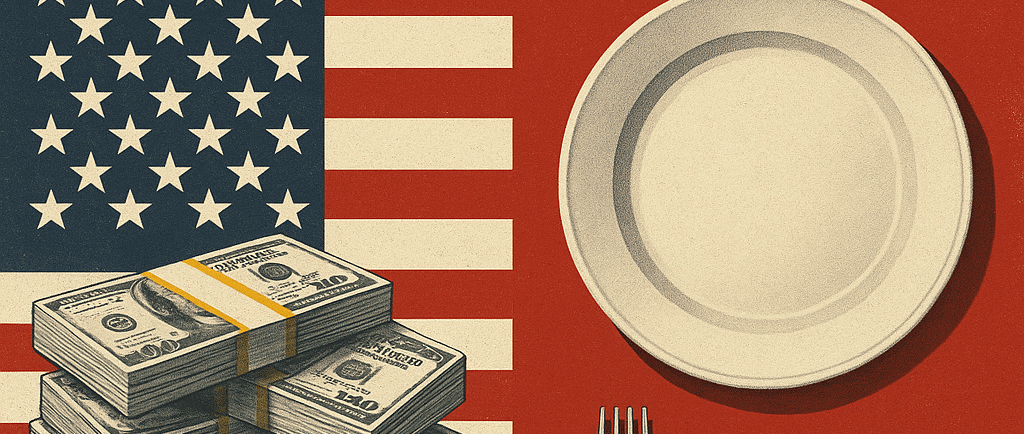
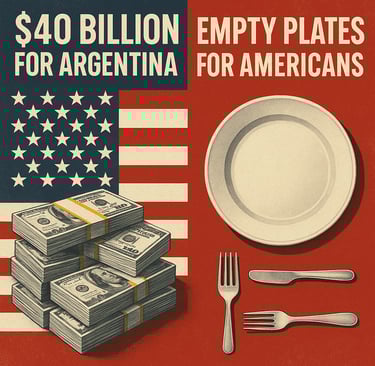
$40 Billion for Argentina, Half-Rations for Americans
The Hollow Promise of "America First"
Bottom Line: While the Trump administration scrambled to assemble a $40 billion financing package for Argentina's currency crisis—risking taxpayer money on a serial defaulter—it told American courts it couldn't afford to feed 42 million Americans through the government shutdown. Today, after a federal judge ordered the release of emergency funds, President Trump declared on social media that food benefits "will be given only when the Radical Left Democrats open up government... and not before," using hunger as a negotiating tactic.
The Tale of Two Bailouts
On October 14, 2025, President Trump welcomed Argentina's President Javier Milei to the White House and announced a $20 billion currency swap line to stabilize the peso. Treasury Secretary Scott Bessent promised an additional $20 billion from private banks and sovereign wealth funds, bringing the total package to $40 billion.
"We think his philosophy is correct," Trump said of Milei, the self-described "anarcho-capitalist" who attended Trump's January inauguration and gifted Elon Musk a chainsaw at CPAC earlier this year.
Trump's support came with an unusual condition: "If he wins, we're staying with him, and if he doesn't win, we're gone." The aid was explicitly tied to Milei's party winning Argentina's midterm elections on October 26—which they did.
Meanwhile, as the U.S. government shutdown stretched into its 35th day—now the longest in American history—the same administration insisted it couldn't find money to feed Americans.
On October 10, the USDA sent letters to states warning that SNAP benefits would not be issued November 1. On October 24, the Agriculture Department posted a message blaming Democrats for "holding out for healthcare for illegal aliens and gender mutilation procedures" while "mothers, babies, and the most vulnerable among us" would lose food assistance.
It took two federal judges—in Rhode Island and Massachusetts—ordering the administration to tap emergency contingency funds before any benefits were released. Even then, the administration would only commit to covering 50% of the normal allotment, approximately $4.65 billion of the $9.2 billion needed for November.
Today, President Trump posted on Truth Social that SNAP benefits "will be given only when the Radical Left Democrats open up government, which they can easily do, and not before!"—appearing to reverse even the partial payment commitment his lawyers made to the court just yesterday.
Hours later, White House Press Secretary Karoline Leavitt clarified the administration would comply with the court order, but warned recipients "it would take some time to receive this money." Agriculture Secretary Brooke Rollins suggested it could take "several weeks" to process even the reduced payments.
The message is clear: The administration can move $20 billion to Buenos Aires in days, but it takes weeks—maybe—to move half that amount to American families.
The Math That Doesn't Add Up
Argentina Package:
$20 billion currency swap line from U.S. Treasury (using Exchange Stabilization Fund)
$20 billion additional financing from private banks and sovereign wealth funds
Total commitment: $40 billion
SNAP for November:
$9.2 billion needed for full benefits to 42 million Americans
$4.65 billion released (50% of normal benefits) after court order
Total commitment: 50% of what's needed
To stabilize a foreign currency, the administration found $40 billion. To feed Americans, even $9.2 billion was deemed impossible—until judges forced their hand, and even then, only half.
"America First" Meets American Farmers Last
Perhaps no group feels the sting of this priority more than American farmers—the backbone of Trump's base.
After receiving the first $20 billion in U.S. support, Argentina suspended its export taxes on soybeans. China, which had effectively embargoed American soybeans due to Trump's trade war, immediately pivoted to Argentina, purchasing millions of tons of discounted Argentine soybeans.
American soybean farmers watched helplessly as their government's financial lifeline to Argentina directly enabled their foreign competitor to undercut them in the world's largest market.
"This is such a slap in the face to America's family farmers who are hurting like crazy right now because of Trump's trade war," said Rep. Angie Craig (D-Minn.), ranking member of the House Agriculture Committee.
"Farmers question Trump's $40 billion Argentina bailout while U.S. faces food shortages," reported The Washington Post.
Even some Republicans who championed "America First" are asking: First for whom?
The Risk Nobody's Talking About
Administration officials insist the Argentina package doesn't cost taxpayers a cent because it's structured as a loan, not a grant. Treasury Secretary Bessent told Reuters the U.S. "won't lose taxpayer money."
Here's what they're not emphasizing:
Argentina's Default History: Since 2000, Argentina has defaulted on its sovereign debt three times. The country currently owes the International Monetary Fund $57 billion—more than triple what any other nation owes the IMF and the largest debt in the fund's history. Argentina is, as one economist put it, a "serial defaulter."
"Even if they manage to skate through thin ice this time, there are always more bumps in the road," said Barry Eichengreen, professor of economics at UC Berkeley. "The current strategy is extremely fragile."
The Real Taxpayer Risk: The $20 billion swap line comes from the Exchange Stabilization Fund—a pool of public money created for emergencies. If Argentina defaults (again), American taxpayers absorb the loss. The additional $20 billion from private sources carries indirect risk: if those private lenders face losses, the Trump administration may feel political pressure to bail them out.
Critics point out that the same Treasury Secretary promising no taxpayer losses has friends who run hedge funds heavily invested in Argentina. The New York Times reported that "major hedge funds, including those led by friends of Treasury Secretary Scott Bessent, could benefit financially from the bailout. Funds at investment firms including BlackRock, Fidelity and PIMCO [are] heavily invested in Argentina."
One prominent economist called Trump's conditional aid—tying financial support to electoral outcomes—a "quasi-colonial incursion" into Argentina's domestic affairs.
The Shutdown Weapon: SNAP as Political Leverage
SNAP is not just any government program. It's the largest anti-hunger initiative in the country, serving approximately 1 in 8 Americans—42 million people, including 16 million children.
For most participants, SNAP is the only direct assistance they receive. The average benefit is $187 per person per month, or roughly $6 per day for groceries. Nearly 39% of recipients are children and adolescents under 18. The vast majority of the rest are seniors, people with disabilities, and working families whose jobs don't pay enough to cover both rent and food.
Food banks provide nine times fewer meals than SNAP does. When SNAP fails, food banks cannot fill the gap.
"If the SNAP program shuts down, we will have the most mass hunger suffering we've had in America since the Great Depression," warned Joel Berg, CEO of Hunger Free America.
SNAP doesn't just feed people—it stabilizes local economies. Each month, the federal government distributes approximately $8 billion in benefits to more than 250,000 food retailers nationwide. SNAP accounts for roughly 9% of all grocery spending in the United States. Every dollar in SNAP benefits generates $1.50 to $1.80 in economic activity.
The decision to freeze these benefits during a shutdown is unprecedented. SNAP dates back to the Great Depression and has never been completely disrupted—not even during previous government shutdowns. During Trump's first-term shutdown in 2019, his own administration issued guidance stating that contingency funds should be used to continue SNAP benefits during funding lapses.
This time, the administration initially refused. It took lawsuits from multiple states and court orders to force compliance—and even then, only for half-payments, with Trump declaring this morning that even those funds should be withheld as political leverage.
The Hunger Games, Washington Edition
As courts battled to force the release of emergency food aid, President Trump hosted a "Great Gatsby"-themed Halloween party at Mar-a-Lago on October 31—hours before SNAP benefits lapsed for millions of Americans.
Guests arrived in 1920s attire. Flapper-clad hosts greeted invitees including Secretary of State Marco Rubio and members of the Trump family. The symbolism was not lost on critics: the administration was literally throwing a party themed around the excess and inequality of the Roaring Twenties while Americans faced food insecurity reminiscent of the Depression that followed.
On November 1, the benefits stopped. Approximately 3 million Americans who should have received their SNAP allotments that day got nothing. By November 5, nearly 13.7 million Americans were affected.
Food banks reported immediate spikes in demand. States scrambled to respond with their own emergency measures:
California allocated $80 million to food banks
Ohio provided $25 million in state funding
North Carolina offered $10 million plus $8 million from private organizations
Multiple other states cobbled together emergency relief packages
But even these substantial state efforts cannot replace $9 billion in monthly federal food assistance. Food bank administrators warned that the loss of November benefits could trigger a public health crisis.
Michelle DeWitt, executive director of Bethel Community Services Foundation in Alaska, said the state's "formal food security safety nets are already stretched thin" even before the shutdown.
Meanwhile, in court filings, USDA officials warned that depleting the contingency fund means "no funds will remain for new SNAP applicants certified in November, disaster assistance, or as a cushion against the potential catastrophic consequences of shutting down SNAP entirely."
The Legal Battle and the Political Theater
On October 31, two federal judges—one in Rhode Island, one in Massachusetts—ruled that the Trump administration must use emergency contingency funds for SNAP benefits.
Judge John McConnell in Rhode Island wrote: "There is no question that the congressionally approved contingency funds must be used now because of the shutdown; in fact, the president during his first term issued guidance indicating that these contingency funds are available if SNAP funds lapse due to a government shutdown."
Initially, Trump responded on Truth Social: "I do NOT want Americans to go hungry just because the Radical Democrats refuse to do the right thing and REOPEN THE GOVERNMENT." He said he would ask his lawyers for clarity on how to "legally fund SNAP as soon as possible."
Judge McConnell noted in a footnote: "The court greatly appreciates the president's quick and definitive response to this court's order and his desire to provide the necessary SNAP funding."
But the administration's actual compliance told a different story. On Monday, November 3, USDA officials informed the court they would only use the $4.65 billion contingency fund—covering 50% of benefits—and refused to tap into at least $4 billion in additional funds from the Child Nutrition Program that the court suggested could be transferred.
Then, this morning, Trump posted that SNAP benefits "will be given only when the Radical Left Democrats open up government, which they can easily do, and not before!"
Democracy Forward CEO Skye Perryman, whose organization is leading the lawsuit, responded simply: "This is immoral. See you in court."
Hours later, facing potential contempt charges, the White House walked it back. Press Secretary Leavitt said Trump was only referring to full benefits, not the partial payment. But the damage—and the message—had been sent: hungry Americans are negotiating leverage.
A new court hearing is scheduled for Thursday to determine whether the administration must provide full benefits.
The Economic Monroe Doctrine: Who Does It Serve?
Treasury Secretary Bessent has framed the Argentina bailout as part of a new "economic Monroe Doctrine"—using American financial power rather than military force to secure U.S. influence in the Western Hemisphere.
The historical Monroe Doctrine, articulated in 1823, opposed European colonialism in the Americas. Bessent's version appears focused on countering Chinese influence—particularly China's deepening economic ties with Latin America.
There's a legitimate strategic concern here. China has become Argentina's second-largest trading partner and a major creditor. In 2020, Argentina arranged an $18 billion currency swap with China, $5 billion of which Argentina activated in 2024.
But if the goal is protecting American interests, why did the U.S. bailout enable Argentina to undercut American farmers? Why structure aid that directly benefits Treasury Secretary Bessent's allies in the hedge fund industry?
Critics argue the package has less to do with grand strategy and more to do with propping up a political ally. Trump's conditional support—explicitly tying continued aid to Milei's electoral success—suggests a highly personalized foreign policy divorced from broader American interests.
In Argentina itself, the response has been mixed. Former President Cristina Fernández, under house arrest after a corruption conviction, wrote on social media: "Trump to Milei in the United States: 'Our agreements depend on who wins election.' Argentines... you already know what to do!"
Opposition leader Martín Lousteau said: "Trump doesn't want to help a country—he only wants to save Milei."
Even within Argentina's business community, there's skepticism that $40 billion will address the country's systemic problems. "Decades of successive financial crises have taught Argentines that if there is even an iota of doubt about a government stabilization program, buy as many dollars as you can while the government is offering them cheaply," notes an analysis from the American Enterprise Institute.
Translation: The money may simply flow right back out of Argentina as citizens and businesses convert pesos to dollars and move wealth offshore—exactly what has happened in previous bailout attempts.
The Bipartisan Failure—With a Difference
The government shutdown itself is a bipartisan failure. Democrats are holding out for the extension of Affordable Care Act subsidies that would keep health insurance premiums from spiking for 20 million Americans. Republicans want those subsidies to expire.
Both parties bear responsibility for the gridlock.
But the Argentina-SNAP contrast is not a bipartisan issue. This is purely executive branch decision-making:
The Argentina Package: Arranged unilaterally by the Trump administration using the Exchange Stabilization Fund, which doesn't require Congressional approval. Treasury Secretary Bessent made the decision. President Trump announced it. No Congressional vote needed.
The SNAP Crisis: While Congress controls SNAP appropriations, the administration controls emergency responses. Previous presidents—including Trump in his first term—used contingency funds to maintain SNAP during shutdowns. This administration initially refused, arguing it lacked authority (an argument two federal judges rejected). The decision to freeze benefits was made by USDA Secretary Brooke Rollins. The decision to seek only partial restoration was made by the Trump administration. The decision this morning to threaten even those partial benefits came from the President himself.
Democrats demanding healthcare subsidies are fighting for domestic priorities. The Trump administration is fighting to use hunger as negotiating leverage while simultaneously funneling billions overseas.
What $40 Billion Could Do at Home
To understand the scale of what we're discussing, consider what $40 billion could fund domestically:
SNAP for four months: $40 billion would cover SNAP benefits for 42 million Americans for approximately four full months
School lunch programs: Full funding for the National School Lunch Program for an entire year (approximately $15 billion annually) plus WIC (approximately $5 billion annually), with $20 billion left over
Food bank infrastructure: The entire annual budget for Feeding America's network of 200 food banks is approximately $3 billion—meaning $40 billion could fund the entire food bank system for more than a decade
Child nutrition programs: Complete funding for Summer EBT (approximately $2.5 billion), the School Breakfast Program (approximately $5 billion), and the Child and Adult Care Food Program (approximately $4 billion)—with $28 billion remaining
This isn't an argument against all foreign aid. Strategic international engagement serves American interests. But the contrast between the speed, scale, and certainty of the Argentina package versus the bureaucratic resistance to feeding Americans reveals something deeper about priorities.
The Moral Arithmetic
This administration has demonstrated it can:
Move $20 billion in days when a foreign president visits the White House
Arrange an additional $20 billion from private sources within weeks
Use executive authority to bypass Congressional approval when it wants to
But when it comes to feeding Americans:
It required two federal lawsuits to access emergency funds
It took three weeks of shutdown before releasing even partial benefits
It continues to resist using additional available funds for full benefits
The President threatened this morning to withhold even court-ordered payments as political leverage
The administration fought for corporate tax breaks and got them. It fought for the border wall and declared a national emergency to grab funds. It fought for Argentina and wrote a check within days.
It didn't fight for 42 million Americans whose food assistance was being strangled by political dysfunction. That's not gridlock. That's a choice.
The Empty Slogan
"America First" was supposed to mean putting American workers, American families, and American interests ahead of foreign entanglements. It was supposed to mean ending the era of nation-building abroad while neglecting needs at home.
Instead, we have:
$40 billion pledged to stabilize a foreign currency
American farmers undercut by a U.S.-funded competitor
Treasury officials with potential financial conflicts of interest
Foreign aid explicitly conditioned on electoral outcomes
42 million Americans used as bargaining chips in budget negotiations
The President threatening to defy court orders to feed children
"America First" has become a marketing slogan covering for a foreign policy driven by personal relationships and a domestic policy willing to use hunger as a weapon.
When USDA Secretary Rollins said the "silver lining" of the SNAP crisis is that it has "shined a light on a program that... has just become so bloated, so broken, so dysfunctional, so corrupt," she revealed the administration's actual view: that food assistance for poor Americans is the problem, not 42 million people going hungry during a government shutdown.
Meanwhile, lending $20 billion to a serial defaulter with a history of economic mismanagement? That's apparently sound fiscal policy.
The Question That Won't Go Away
The next time someone waves the "America First" flag, ask them this:
If Argentina's currency deserves $40 billion in American support, why don't American children deserve their $187 per month in grocery money?
If the Treasury Secretary can find emergency funds for Buenos Aires without Congressional approval, why did it take federal judges to force the release of emergency funds for Boston, Birmingham, and Boise?
If American soybean farmers are hurting because of trade wars, why did we fund their competitor?
If stabilizing foreign economies is a strategic priority, when did feeding our own citizens become optional?
The answers reveal an uncomfortable truth: "America First" was always a slogan, never a policy. The forgotten men and women Trump promised to champion? They're still forgotten—this time at the dinner table.
A Reckoning Coming
History won't record this as just another government shutdown. It will record it as the moment an administration chose to risk taxpayer money on a foreign government's currency while threatening to defy court orders to feed American children.
There's nothing patriotic about that. There's nothing strategic about it. There's certainly nothing "great" about it.
A nation that writes $40 billion checks overseas while arguing it can't find $9 billion to prevent mass hunger at home isn't "first." It's morally bankrupt.
And every American who goes to bed hungry tonight while the administration touts its "economic Monroe Doctrine" knows it.
Editor's Note: This article was written on November 4, 2025, Day 35 of the government shutdown. The Trump administration has announced it will provide 50% of normal SNAP benefits using contingency funds after a federal court order, though the President threatened this morning to withhold even those funds until Democrats vote to end the shutdown. A court hearing is scheduled for Thursday to consider whether the administration must provide full benefits. The shutdown is now the longest in U.S. history.
Sources and Further Reading
NBC News: "U.S. support for Argentina could hit $40 billion" (October 2025)
PBS NewsHour: "Trump administration working on doubling Argentina financing to $40 billion" (October 2025)
NPR: "'Uncharted territory': Ongoing shutdown threatens food aid for 42 million people" (October 2025)
Washington Post: "Who Receives SNAP? Food Aid for 1 in 8 Americans Is Threatened" (October 2025)
Britannica: "Why Is the U.S. Bailing Out Argentina?" (October 2025)
Democracy Now: "Why Is Trump Bailing Out Argentina's President Milei While Firing Thousands of Workers in U.S.?" (October 2025)
American Enterprise Institute: "Use the $40 Billion to Dollarize Argentina" (October 2025)
Snopes: "Did Trump agree to 'bail out' Argentina? Unpacking the claim" (October 2025)
CNN Politics: "White House says it will partially fund SNAP benefits after Trump threatens to withhold them" (November 2025)
CBS News: "After Trump post on SNAP funds sparks confusion, White House says administration is complying with court order" (November 2025)
Home | My Books| About Paul Zurav | Taking a Closer Look | Privacy Policy | Contact
Copyright: © 2026 CTEK LLC / Paul Zurav