
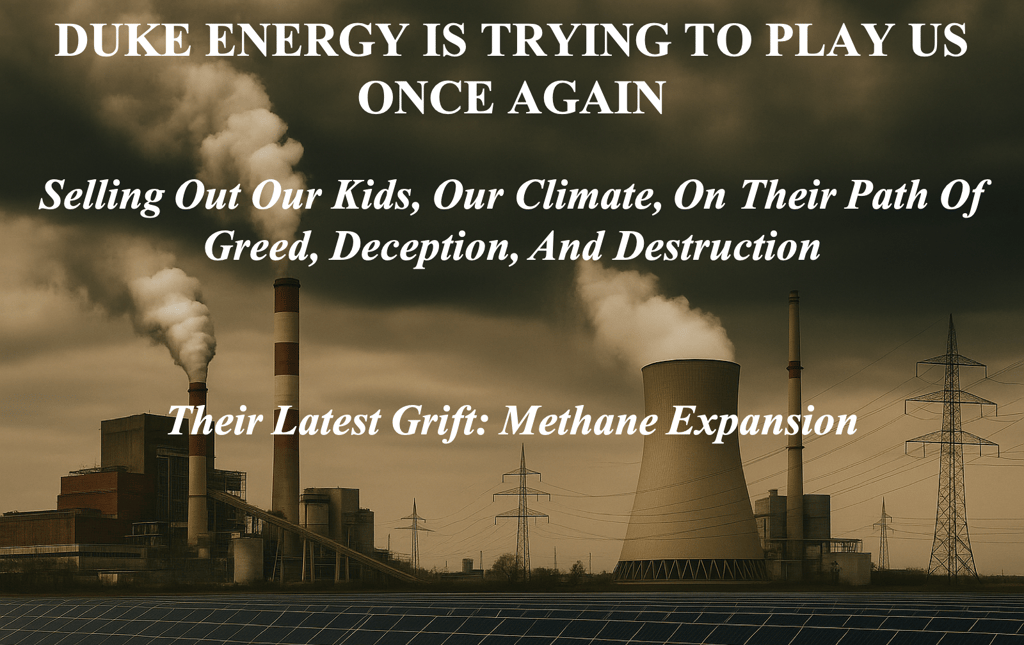
DUKE ENERGY IS TRYING TO PLAY US ONCE AGAIN
How Duke Energy Is Selling Out Our Kids, Our Climate, On Their Path Of Greed, Deception, And Destruction
11/6/202513 min read
DUKE ENERGY'S BETRAYAL:
How North Carolina's Monopoly Utility Is Forcing Ratepayers to Fund a Fossil Fuel Future While Profiting from a History of Environmental Crimes
The Crime in Progress
Let's not mince words: Duke Energy is forcing North Carolina ratepayers to fund the construction of approximately 3.6 gigawatts of new natural gas plants—the MORE expensive, MORE polluting option—while sitting on one of the worst environmental crime records in American utility history. This isn't speculation. This isn't hyperbole. This is documented fact, backed by $2.95 billion in fines, nine guilty pleas to federal crimes, and a coal ash disaster that poisoned 70 miles of the Dan River.
And here's the sick genius of it: you're paying for all of it. Duke's shareholders profit. Duke's executives get their bonuses. And you—the captive ratepayer with no ability to switch providers—get stuck with the bill for their negligence, their greed, and now, their decision to double down on fossil fuels when solar and wind are cheaper, cleaner, and faster to deploy.
This isn't just bad business. This is corporate malfeasance at civilizational scale, enabled by regulatory capture and a monopoly power structure that makes accountability nearly impossible.
The Players and the Stage
Duke Energy: America's Largest Utility and Serial Environmental Offender
Duke Energy controls approximately 70% of North Carolina's electricity market, serving 4.8 million captive customers across the Carolinas. You cannot switch providers. You cannot vote with your wallet. You are trapped in a system where Duke holds all the cards, writes the rules through $80 million in annual lobbying expenditures, and has proven—repeatedly—that it will choose profits over public safety.
Since 2000, Duke has racked up $2.95 billion in environmental penalties across six states. In 2015, Duke Energy subsidiaries pleaded guilty to nine criminal violations of the Clean Water Act—the largest federal criminal fine in North Carolina history at $102 million. This wasn't a one-off disaster. Federal prosecutors found that Duke knew about numerous leaks and violations across multiple facilities for years and chose to do nothing.
The Monopoly Structure: Where Competition Dies and Accountability Evaporates
Duke's business model is elegantly simple and devastatingly effective: build expensive infrastructure, get state regulators to approve it, charge ratepayers for the cost plus a guaranteed 9-10% return on investment. More infrastructure equals more profit, regardless of whether that infrastructure is the cheapest option, the cleanest option, or even necessary.
Because Duke faces no competition in most of its North Carolina service territory, there is no market pressure to minimize costs or maximize efficiency. The North Carolina Utilities Commission (NCUC) is supposed to provide oversight, but the NCUC relies heavily on Duke's own data for decision-making, and Duke's political spending ensures that regulations remain friendly to utility interests.
Consider the obvious conflict of interest: Former Governor Pat McCrory worked for Duke Energy for 29 years before entering politics. During the Dan River coal ash spill, his administration proposed a sweetheart deal where Duke would pay just $99,111 in fines for massive groundwater contamination—a fine so absurdly low that federal prosecutors had to intervene.
The Evidence: What Duke Is Doing NOW
The 2025 Carolinas Resource Plan: Fossil Lock-In Disguised as Transition
In November 2024, the North Carolina Utilities Commission approved Duke's latest resource plan. Here are the numbers:
· Natural gas plants: 3.6 GW (38.5% of new capacity)
· Solar: 3.46 GW (37.0%)
· Onshore wind: 1.2 GW (12.8%)
· Battery storage: 1.1 GW (11.8%)
That gas buildout—900 MW of combustion turbines plus 2,720 MW of combined cycle plants—locks North Carolina into decades of fossil fuel dependence. These plants will operate for 30-40 years, during which ratepayers will bear all fuel cost risk while Duke collects guaranteed profits.
Even more disturbing: Duke has eliminated wind entirely from some portfolio scenarios. Offshore wind, which could provide massive clean baseload power, has been relegated to a distant maybe with minimal commitments. Meanwhile, solar deployment has been delayed and downscaled.
Regulatory Capture: How Duke Weakened the Law
In 2021, North Carolina passed legislation requiring Duke to achieve a 70% reduction in CO₂ emissions by 2030 and net-zero by 2050. These were enforceable targets designed to hold Duke accountable.
In March 2025, the North Carolina Legislature—after intense lobbying by Duke—eliminated the 70% reduction target by 2030. The NCUC waived the requirement to even model achieving that target, instead directing Duke to pursue all reasonable steps to hit 70% reduction by the earliest possible date—language so vague it's essentially meaningless.
Translation: Duke successfully lobbied to remove the one enforceable mechanism that would have required rapid decarbonization. The 2050 net-zero goal remains on paper, but with no interim checkpoints, there's no accountability for the next two decades.
The Economics: Why This Is Catastrophically Stupid
The Numbers Do Not Lie: Gas Is More Expensive
According to Lazard's 2025 Levelized Cost of Energy (LCOE) analysis—the gold standard for comparing electricity generation costs—here's what new-build generation actually costs:
· Utility-scale solar: $38-78 per megawatt-hour (MWh)
· Solar + battery storage: $50-131/MWh
· Gas combined cycle: $48-107/MWh
· Gas peaker plants: $138-262/MWh
Even at the high end, solar plus storage is cheaper than gas peakers and competitive with combined cycle plants. And here's the kicker: solar and wind have zero fuel costs. Build them once, and the electricity is essentially free forever. Gas plants, by contrast, lock you into decades of volatile fuel price exposure.
When natural gas prices spiked in 2022, Duke customers saw their bills jump accordingly. Duke didn't bear that risk—you did. Duke just passed the fuel costs straight through to your bill and kept collecting its guaranteed profit margin on the infrastructure.
The Stranded Asset Time Bomb
Duke is building gas plants that will operate until 2060-2070. But carbon regulations—whether driven by federal policy, state mandates, or simple economic reality as clean energy gets even cheaper—are only going to tighten. When those gas plants become economically obsolete or are forced offline by climate policy, Duke will demand that ratepayers keep paying for them anyway through rate recovery mechanisms.
This is the stranded asset trap: you pay to build the plant, you pay for the fuel, and then you pay again when the plant has to shut down early because it's no longer viable. Duke profits at every stage. You bear all the risk.
The Opportunity Cost: Billions Wasted
Every billion dollars Duke spends building gas plants is a billion dollars not spent on solar, wind, and storage—technologies that are cheaper, faster to deploy (12-24 months vs. 5-7 years for gas), and create zero emissions.
Solar and wind also create more local jobs. Installation and maintenance provide employment in communities across North Carolina, rather than concentrating wealth in Duke's centralized infrastructure. But distributed generation threatens Duke's monopoly model, so Duke has consistently fought third-party solar, net metering expansions, and community solar programs.
The Pattern: Environmental Crimes and Negligence
If Duke's current plan sounds reckless, understand that recklessness is Duke's established pattern. This is a company with a documented history of choosing short-term profits over long-term safety, ignoring warnings from its own employees, and making ratepayers pay for the cleanup after disasters.
The Dan River Disaster (February 2014)
On February 2, 2014, a stormwater pipe beneath Duke's Dan River Steam Station coal ash pond ruptured, spilling between 39,000 and 82,000 tons of toxic coal ash into the Dan River. The sludge spread 70 miles downstream, contaminating drinking water sources for communities in North Carolina and Virginia.
The coal ash contained arsenic, lead, mercury, chromium, selenium, cadmium, and other heavy metals. CNN reported that the river turned into oily sludge. Thousands of aquatic species died immediately. Only about 10% of the spilled ash was ever recovered.
Here's what makes this a crime rather than an accident: Duke knew about the problem. Plant employees had requested $20,000 to inspect the pipes using cameras. Duke headquarters denied the request. At another facility (Moncure), employees reported a leaking pipe in 2011; Duke took no action for two years.
Federal prosecutors found that Duke's violations dated back to at least 2010. At the Asheville plant, Duke illegally channeled contaminated wastewater directly into the French Broad River. These weren't oversights—these were repeated, knowing violations of federal law.
The Broader Coal Ash Scandal
The Dan River spill wasn't an isolated incident—it was the visible tip of a massive problem. Duke operates 32 coal ash ponds at 14 facilities across North Carolina, storing more than 108 million tons of toxic waste. Every single one of those facilities had groundwater contamination violations.
Duke's standard practice was to dig unlined pits next to rivers and lakes, dump coal ash in them, and leave them there—sometimes for decades. When Duke closed coal plants, they just walked away, leaving the toxic ash ponds exactly where they were, leaching poison into groundwater and surface water.
Environmental groups tried to sue Duke three times in 2013 to force cleanup. All three times, state regulators under Governor McCrory (Duke's former employee) blocked the lawsuits and proposed minimal fines. It took a federal criminal investigation to force accountability.
Nine Guilty Pleas and $102 Million in Federal Fines
In May 2015, three Duke Energy subsidiaries pleaded guilty to nine criminal violations of the Clean Water Act. Federal prosecutors laid out a damning case:
· Unlawfully failing to maintain equipment at Dan River and Cape Fear facilities
· Unlawfully discharging coal ash and coal ash wastewater from Dan River, Asheville, Lee, and Riverbend facilities
· Knowing about leaks and contamination for years while taking no corrective action
· Ignoring repeated warnings from employees about structural problems
· Operating under pervasive system-wide shortcomings in environmental controls
The criminal fine: $68 million. Additional penalties and restitution brought the total to $102 million—the largest federal environmental fine in North Carolina history. Duke also paid $34 million for environmental restoration projects and was placed on five years of probation with court-appointed monitoring.
But here's the truly outrageous part: Duke initially tried to pass 100% of the cleanup costs—estimated at $5.6 billion and climbing—to ratepayers. It took a lawsuit by the North Carolina Attorney General, the NC Utilities Commission Public Staff, and the Sierra Club, plus a state Supreme Court ruling, to force Duke to absorb $1.1 billion of the cleanup costs. Ratepayers are still paying for the rest.
Violations Across Six States
North Carolina isn't unique. Duke's coal ash problems span its entire operating territory:
· Indiana: 35.6 million tons of coal ash stored; $93 million settlement for Clean Air Act violations at Gallagher Plant
· Ohio: 5.9 million tons of coal ash stored; multiple Clean Air Act violations
· Kentucky: 1.5 million tons of coal ash stored; environmental compliance failures
· South Carolina: 5.99 million tons of coal ash stored; part of Carolinas groundwater contamination
· Multi-state Clean Air Act violations: 15-year lawsuit for illegally modifying 25 coal units at 8 plants without permits
Total documented penalties since 2000, according to Violation Tracker: $2.95 billion.
The Pattern Is Clear
Here's Duke's playbook:
· Operate facilities illegally to save money (skip permits, skip pollution controls, skip maintenance)
· Ignore warnings from employees about safety problems
· Get caught by federal prosecutors or environmental groups
· Fight accountability through litigation that drags on for years
· Rely on regulatory capture—state regulators who are either former Duke employees or dependent on Duke's political donations
· Eventually settle for fines that are a fraction of profits
· Attempt to pass all cleanup and compliance costs to ratepayers
· Resume business as usual
This isn't theoretical. This is Duke's documented behavior over 25 years.
Why This Is a Moral Catastrophe
The Climate Imperative We're Ignoring
The Intergovernmental Panel on Climate Change has been crystal clear: we need immediate, deep emissions cuts this decade to avoid catastrophic climate impacts. Every ton of CO₂ matters. Every year of delay matters.
North Carolina is already experiencing the consequences: more intense hurricanes (remember Florence in 2018?), increased flooding, heat waves, and ecosystem damage. Building 3.6 GW of new gas plants—infrastructure that will operate for 30-40 years—is choosing to make the problem worse when cheaper, cleaner alternatives exist.
This isn't a both sides issue where reasonable people can disagree. The science is settled. The economics favor renewables. Duke is simply choosing harm over health because their business model profits from big infrastructure projects.
The Betrayal of Public Trust
Duke Energy is not a normal business. It's a state-sanctioned monopoly with legal obligations to serve the public interest, not just maximize shareholder returns. When you control 70% of a state's electricity market and customers have no alternative, you bear a higher burden of responsibility.
The public expects three things from its utility:
· Reliable power (renewables + storage can deliver this)
· Affordable power (solar and wind are cheaper than gas)
· Clean power that doesn't poison their water or wreck the climate (gas fails this test)
Duke is failing on all three counts while using political power to prevent competition and accountability.
Environmental Injustice: The Poor Pay Most
Low-income families spend a higher percentage of their income on electricity. They have less ability to install rooftop solar or make energy efficiency upgrades. They live in areas more exposed to pollution from fossil fuel plants and more vulnerable to climate impacts like flooding and heat waves.
Duke's gas expansion makes all of this worse: higher bills from fuel price volatility, more air pollution, more climate risk. Meanwhile, Duke's shareholders and executives reap the profits.
This is Duke privatizing profits while socializing costs—and the costs fall disproportionately on those least able to bear them.
What North Carolinians Can Actually Do
Duke's monopoly power is not absolute. Regulatory oversight matters. Political pressure matters. Public mobilization matters. Here's your action plan:
1. Submit Comments to the NC Utilities Commission
The NCUC reviews Duke's resource plans and rate cases. Public comments are part of the official record and influence decisions. Key points to make:
· Demand detailed, all-in cost comparisons between gas and solar + storage (including fuel costs, maintenance, carbon risk, stranded asset risk)
· Question why Duke eliminated wind from portfolios when it's cost-competitive
· Ask how ratepayers will be protected if gas plants become stranded assets
· Insist on accelerated renewable deployment timelines
· Demand transparency about Duke's financial relationships with gas suppliers and contractors
Visit ncuc.gov to find active dockets and comment periods.
2. Contact Your State Legislators
Find your representatives at ncleg.gov. Call them, email them, meet with them. Frame this as an economic issue first:
· Duke is charging us MORE for DIRTIER energy
· Restore and strengthen the 70% CO₂ reduction target by 2030 with enforceable interim milestones
· Require Duke to prove that all new infrastructure is the lowest-cost option for ratepayers
· Support third-party solar, community solar, and grid modernization that enables distributed generation
· Increase NCUC oversight powers and funding for independent analysis
· Prevent Duke from shifting stranded asset costs onto ratepayers
3. Join or Support These Organizations
NC WARN: ncwarn.org - Duke Energy watchdog and clean energy advocacy
Southern Environmental Law Center: southernenvironment.org - Legal challenges and policy advocacy
NC Sustainable Energy Association: energync.org - Clean energy policy and education
Sierra Club North Carolina: sierraclub.org/north-carolina - Grassroots organizing and campaigns
Environmental Defense Fund: edf.org - Climate policy and utility regulation
4. Use Media and Public Pressure
Write letters to the editor:
· News & Observer (Raleigh): newsobserver.com
· Charlotte Observer: charlotteobserver.com
· Greensboro News & Record: greensboro.com
· Winston-Salem Journal: journalnow.com
Keep letters under 200-250 words. Lead with economics: Duke is forcing us to pay more for dirtier energy.
Use social media:
· Share cost comparisons: Solar $38-78/MWh vs. Gas $48-262/MWh
· Highlight Duke's criminal record: 9 guilty pleas, $2.95B in fines
· Frame as monopoly abuse: 70% of NC has no choice. No competition = no accountability
· Tag @DukeEnergy, local news, and elected officials
· Use hashtags: #DukeEnergy #NorthCarolina #CleanEnergy
5. Demand Answers to These Questions
· What are the all-in lifecycle costs (capital, fuel, maintenance, carbon risk, stranded asset risk) of new gas vs. solar + storage? Show us the math.
· Why was onshore wind eliminated from portfolios when it's cost-competitive with gas?
· What financial relationships exist between Duke executives and natural gas suppliers, pipeline companies, and contractors?
· How will ratepayers be protected if gas plants become economically obsolete before their planned retirement dates?
· Why is Duke's plan locking in 38.5% fossil fuel capacity when renewables are cheaper and faster to deploy?
· Given Duke's history of environmental crimes and $2.95 billion in penalties, why should we trust them with another multi-billion dollar infrastructure bet?
The Verdict: Exhibit A in the Crime Against the Biosphere
Duke Energy's 2025 Carolinas Resource Plan is not a transition. It's not modernization. It's not even a calculated business risk. It's a betrayal.
When the cheapest, cleanest energy sources in history are finally available at scale—when solar and wind are beating fossil fuels on pure economics—Duke Energy is choosing to build more gas plants and delay renewables. They're doing this because their business model profits from large, centralized infrastructure projects, and because their monopoly power means they face no competitive pressure to minimize costs or maximize efficiency.
They're doing this with a documented history of environmental crimes: 9 guilty pleas, $2.95 billion in fines, between 39,000 and 82,000 tons of toxic coal ash spilled into drinking water, and a pattern of ignoring employee warnings about safety problems while passing cleanup costs to customers.
They're doing this by spending $80 million annually on lobbying to weaken environmental regulations, block competition, and maintain regulatory capture.
And they're doing this while forcing 4.8 million North Carolinians—who have no alternative, no ability to switch providers, no market power whatsoever—to pay for it all.
This is not conservative business strategy. This is not prudent risk management. This is:
· Economically reckless (choosing more expensive infrastructure with fuel cost risk and stranded asset exposure)
· Environmentally catastrophic (locking in decades of fossil fuel emissions when climate science demands immediate cuts)
· Morally bankrupt (privatizing profits while socializing risks onto captive ratepayers)
· Enabled by monopoly power (no competition, no accountability, no consumer choice)
· Protected by regulatory capture ($80M/year in political spending, revolving door between Duke and state government)
If there is a crime against the biosphere—a mass assault on the ecological systems that sustain human civilization—Duke Energy's 2025 Carolinas Resource Plan is Exhibit A.
And if you are a North Carolina resident and Duke Energy customer, you are being forced to fund it.
The window for climate action is closing. Duke's plan takes us in the wrong direction at the worst possible time. But Duke's monopoly power is not absolute. Organized public pressure, regulatory scrutiny, and political accountability can force change.
The question is whether enough North Carolinians will recognize what's happening and demand better before it's too late.
REFERENCES
Data Sources and Documentation
Lazard. (2025). Levelized Cost of Energy Analysis—Version 18.0. https://www.lazard.com/research-insights/levelized-cost-of-energyplus-lcoeplus/
North Carolina Utilities Commission. (2024, November). Order Accepting Carolinas Resource Plan. Docket No. E-100, Sub 179. https://www.utilitydive.com/news/north-carolina-commission-accepts-duke-energys-carbon-plan/732010/
U.S. Department of Justice. (2015, May). Duke Energy Subsidiaries Plead Guilty and Sentenced to Pay $102 Million for Clean Water Act Crimes. https://www.justice.gov/archives/opa/pr/duke-energy-subsidiaries-plead-guilty-and-sentenced-pay-102-million-clean-water-act-crimes
U.S. Environmental Protection Agency. (2014). Case Summary: Duke Energy Agrees to $3 Million Cleanup for Coal Ash Release in the Dan River. https://www.epa.gov/enforcement/case-summary-duke-energy-agrees-3-million-cleanup-coal-ash-release-dan-river
U.S. Environmental Protection Agency. (2011). Duke Energy Gallagher Plant Clean Air Act Settlement. https://www.epa.gov/enforcement/duke-energy-gallagher-plant-clean-air-act-settlement
North Carolina Department of Environmental Quality. (2016). DEQ and Duke Energy Reach an Estimated $20 Million Settlement. https://www.deq.nc.gov/press-release/deq-and-duke-energy-reach-estimated-20-million-settlement-0
North Carolina Attorney General. (2021, January). Duke Energy Customers to Save Over $1.1 Billion Under New Coal Ash Settlement. https://ncdoj.gov/attorney-general-josh-stein-duke-energy-customers-to-save-over-1-1-billion-under-new-coal-ash-settlement/
WUNC. (2024, February). Toxic Coal Ash Poured Into the Dan River 10 Years Ago. The Spill Left a Legacy of Legislation and Change. https://www.wunc.org/environment/2024-02-02/dan-river-coal-ash-spill-legislation-duke-energy-environment
Violation Tracker (Good Jobs First). Duke Energy Penalty Database. https://violationtracker.goodjobsfirst.org/parent/duke-energy (accessed November 2025)
Canary Media. (2024, November). Regulators OK Duke Energy's Gas-Plant Buildout Despite Clean Energy Alternatives. https://energynews.us/2024/11/04/months-ahead-of-schedule-north-carolina-regulators-accept-duke-energys-controversial-plan-to-reduce-carbon
NC WARN. (2025). Duke Energy Watchdog Reports. https://www.ncwarn.org
Southern Environmental Law Center. (2024). Duke Energy Coal Ash Legal Actions. https://www.southernenvironment.org
Business North Carolina. (2024, November). NC Regulators OK Duke Energy Resource Plan. https://businessnc.com/nc-regulators-ok-duke-energy-resource-plan/
Duke Energy. (2025, October). 2025 Carolinas Resource Plan Filing. https://news.duke-energy.com/releases/duke-energy-files-2025-carolinas-resource-plan
Environmental Working Group. (2019). Public Energy Enemy No. 1: Duke Energy's Monopoly Power and Environmental Record. https://www.ewg.org/research/public-energy-enemy-no-1
Sierra Club. (2019). Coal Ash and Clean Water: The Dan River Spill Five Years Later. https://www.sierraclub.org/articles/2019/02/coal-ash-and-clean-water-dan-river-spill-five-years-later
Additional Resources
North Carolina Utilities Commission Public Filings: https://www.ncuc.gov
NC Department of Environmental Quality Coal Ash Information: https://www.deq.nc.gov/news/key-issues/coal-ash-excavation
U.S. EPA Criminal Prosecutions Database: https://cfpub.epa.gov/compliance/criminal_prosecution/
Energy Information Administration Annual Energy Outlook: https://www.eia.gov/outlooks/aeo/
Home | My Books| About Paul Zurav | Taking a Closer Look | Privacy Policy | Contact
Copyright: © 2026 CTEK LLC / Paul Zurav