The Insanity of Nuclear Testing: A Historical Overview
The insanity of nuclear testing
10/31/20258 min read
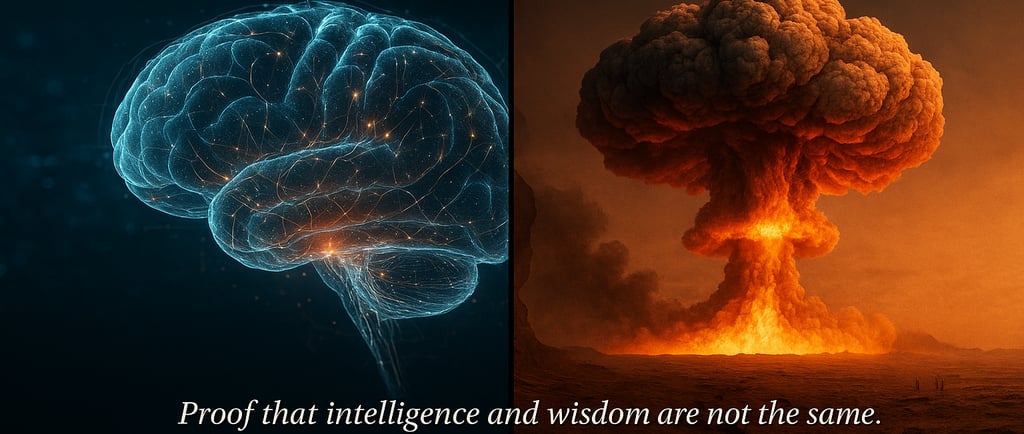
We Are the Intelligent Species??
I. The Crime Scene
We like to think of ourselves as the most intelligent life ever to grace a blue planet. We decode genomes, split atoms, and send telescopes to the edge of creation — then promptly use that intelligence to see how much of creation we can blow up.
From 1945 onward, nations staged a planetary chemistry experiment: detonate a sun, watch the sky turn white, and call it “progress.” The first atomic test in New Mexico was supposed to prove human genius. It ended up proving something closer to insanity — because once we saw the mushroom cloud, we wanted another. And another. And another.
The “nuclear age” arrived with parades and press conferences, complete with patriotic branding. The United States called its tests Operation Crossroads. The Soviets called theirs peaceful explosions. Britain brought its bombs to the beaches of Australia and told Aboriginal families not to worry. It was the age when men in white coats stood in front of cameras describing apocalypses as data collection.
By the end of the twentieth century, humanity had conducted more than 2,000 nuclear tests, each one a demonstration that the smartest species on Earth was also the only one testing whether Earth could survive it.¹
II. The Evidence of Harm
The evidence still glows — literally — in the soil, the bones, and the birth records.
The Pacific Proving Grounds
Between 1946 and 1958, the United States turned the Marshall Islands into a laboratory of radiation. Villages were relocated — sometimes after the blast, not before — and the fallout drifted farther than any map predicted. In 1954, Castle Bravo vaporized a coral island and showered radioactive ash over fishing fleets and families alike. Children played in the “snow” before their skin peeled away. Later studies measured thyroid doses exceeding 2,000 mSv — a hundred times the limit considered safe.²
Decades later, Simon et al. (2010) documented persistent thyroid cancer, leukemia, and birth defects among the exposed.³ Entire bloodlines now carry what one researcher called “a biological signature of empire.”
Kazakhstan’s Silent Wounds
Half a world away, the Semipalatinsk Test Site became the Soviet Union’s mirror image. From 1949 to 1989, more than 450 tests scarred the Kazakh steppe, exposing over 1.5 million people.⁴ Radiation seeped into milk, river mud, and the DNA of newborns. Zaitsev et al. (2021) found germline mutations, TP53 and HPRT deletions, and elevated micronuclei in blood cells — markers of multi-generational damage.⁵
Families here don’t speak of “survivors.” They speak of “the irradiated,” because there is no end date to exposure when the half-life of cesium-137 is thirty years and plutonium-239 is twenty-four thousand.
Health Without Borders
Radiation, unlike politics, ignores borders. Traces from every detonation rode wind and water until they reached dinner plates on the other side of the world. By the 1960s, milk in Chicago and rice in Tokyo carried isotopes from faraway tests.⁶ Children born during that decade still show measurable strontium-90 in their teeth.⁷
The so-called “global fallout” became the only truly international treaty of the Cold War — signed invisibly by everyone.
III. The Climate Witness
If radiation poisoned the body, nuclear smoke threatened the sky.
Modern climate models — Robock et al. (2020) and later CESM2 simulations (2022) — show that even a limited exchange of 100 low-yield detonations could inject 3–5 teragrams of black carbon into the stratosphere, cooling the planet by 1.5 to 2 °C for years.⁸ ⁹ Monsoons would falter; global crop yields could drop by 20–50 percent. Starvation would not respect alliances.
The irony: we once called nuclear weapons a deterrent. They now double as a preview of climate catastrophe. Each bomb test was a miniature rehearsal for geo-engineering by hubris — a trial run for turning sunlight into shadow.
Even the first detonations altered atmospheric chemistry. Ozone depletion spikes were recorded after high-altitude tests in the 1960s.¹⁰ Scientists warned that stratospheric heating and “artificial night” could devastate agriculture long before climate change became dinner-table vocabulary.
Yet, through the 1980s, generals still stood on viewing platforms wearing sunglasses instead of moral ones. When the dust settled, they congratulated each other for “scientific success.” The crops didn’t.
IV. The Genetic Witnesses
Radiation doesn’t merely kill; it edits. And unlike human editors, it never proofreads.
In the years since the last major test, biologists have found the evidence written in genomes across the fallout zones. Studies in Semipalatinsk and the Marshall Islands reveal mutations in the TP53 and ATM genes — the same guardians that normally prevent cancer.¹¹ Epigenetic research shows altered DNA-methylation patterns that persist for generations, effectively rewriting inheritance itself.¹²
Soil microbes mutate faster, plants accumulate errors in chloroplast DNA, and animals born decades after the blasts exhibit chromosomal aberrations once thought impossible outside laboratories. The fallout became a form of evolution by detonation.
The International Atomic Energy Agency quietly confirms that ecosystems in Kazakhstan and Polynesia still display accelerated mutation rates, distorting food chains and biodiversity alike.¹³ Radiation didn’t stop at the perimeter fences; it became a tenant of the biosphere.
If nature had a courtroom, these would be the witnesses — species whose testimony is written not in words but in warped genes. They would all point at us and say: You did this.
V. The Earth’s Testimony
If the human genome is scarred, the planet’s crust is disfigured.
Every test site is a wound that never healed — a scar tissue of glass, cesium, and lies.
The Soils That Remember
At Bikini Atoll, Geiger counters still chatter like nervous teeth. Even after decades of “cleanup,” soil samples register 34,000 Bq/kg of cesium-137 and 18,000 Bq/kg of strontium-90.¹⁴ Bananas grown there would fail import inspection anywhere else, yet the U.S. once encouraged displaced islanders to “re-settle.” They returned to gardens that glowed at night.
Across the steppe of Semipalatinsk, radiation maps form bright halos around crater lakes — the legacy of underground tests that breached the surface. Dust storms carry plutonium particles hundreds of miles east toward villages whose names never appeared on Soviet maps. Phytoremediation projects now plant sunflowers and mustard to absorb the isotopes, a fragile peace offering between science and soil. But roots only reach so deep; the aquifers beneath remain poisoned for centuries.
At the Nevada Test Site, the U.S. response was simpler: cap it and fence it. Over 900 craters puncture the desert like a lunar field. Inside the restricted zone, the groundwater contains technetium and tritium that will outlive the fence by millennia. “Containment,” in bureaucratic language, means out of sight, out of funding.
The Water That Speaks
In Polynesia, lagoons around Mururoa Atoll leak radionuclides through fractured coral. French authorities insist the reef “remains stable,” a phrase that appears in every government report where truth would be inconvenient.¹⁵ Yet independent divers record spikes of 17,000 Bq/kg in sediments — enough to classify the area as nuclear waste under European law.
Water is the perfect witness: it carries everything we try to forget. It has delivered our genius from test islands to tuna, from deserts to dinner tables. And it has never once signed a nondisclosure agreement.
VI. The Repeat Offenders
You would think the evidence was sufficient. We irradiated paradise, altered DNA, and flirted with climate collapse. Surely the species that calls itself wise learned something.
Not quite.
North Korea’s Echoes
In 2006, the Punggye-ri mountain in North Korea rumbled. Then again in 2009, 2013, 2016, and 2017. Satellite images captured a mountain slowly deforming, its granite veins cracked by underground fire. The last detonation, roughly 140 kilotons, triggered earthquakes felt across China. Radiation seeped into groundwater that feeds small farming villages.¹⁶ No remediation exists — just propaganda videos declaring victory over “imperialist aggression.”
The Temptation to Resume
The United States still maintains the Nevada site in “standby readiness.” Russia has hinted that the moratorium is “conditional.” China continues sub-critical tests at Lop Nur, calling them hydrodynamic experiments. In 2023, even the U.K. quietly budgeted millions to modernize its test infrastructure “for safety assurance.” Every superpower insists it doesn’t want a new arms race — it just wants to be prepared in case the others start one. It’s the diplomatic version of teenagers playing with matches because “everyone else was doing it.”
Paper Shields
The Comprehensive Nuclear-Test-Ban Treaty was signed in 1996. Twenty-nine years later, it still hasn’t entered full force. Eight key nations — including the U.S., China, and North Korea — have yet to ratify. Meanwhile, the data from seismographs and atmospheric detectors show that smaller tests, “experiments,” and sub-surface events continue under different names.¹⁷
We don’t test weapons anymore, we’re told; we test “materials.” We don’t pollute; we “validate models.” The dictionary of denial keeps expanding faster than the ozone hole we once burned through.
The hypocrisy is geological. We condemn rogue states for detonations while funding laboratories that refine the physics behind them. We preach non-proliferation while modernizing arsenals. Apparently, intelligence includes the ability to rationalize self-destruction in Latin.
VII. The Verdict
Intelligence, in theory, should include foresight. Ours included spreadsheets.
The nuclear century proved that IQ without empathy becomes engineering for extinction.
We built the ultimate teacher — radiation — and it graded us immediately. Fail.
Children born decades after the tests still carry the corrections in their chromosomes. Farmers in the Marshall Islands still can’t eat their coconuts. Kazakh grandmothers still bury infants whose defects have no name. Yet the architects of these policies retired with medals for “service to peace.”
The scientists, to their credit, recorded everything: the dosage, the crater diameter, the isotopic decay curves. What they forgot to record was why. Why a species capable of writing symphonies would also draft blueprints for apocalypse and call it deterrence. Why we classify the aftermath instead of confessing it.
In every other field, experimenters learn from failure. Only in geopolitics do we repeat it with better funding.
If the planet were a courtroom, the evidence would fill continents. Exhibits of glassed desert, testimony written in half-lives. The prosecutor wouldn’t need to speak; the silence of species gone missing would suffice.
And the jury — seven billion of us — would already know the verdict.
Guilty, with continuing intent.
VIII. The Sentence
The sentence has already begun. It’s measured not in years but in isotopes. Cesium in soil. Strontium in bones. Cancer clusters in islands we can’t pronounce. Every time we say “never again,” we mean until next time.
Yet the story isn’t over — because unlike atoms, morality can still decay in reverse.
Restoration is possible, but it demands a different definition of intelligence: one that measures success not by how much energy we can release, but by how much harm we can restrain.
The techniques already exist. Phytoremediation — sunflowers drinking radiation from soil. Zeolite nanomaterials trapping cesium and strontium. In-situ vitrification turning waste into glass. These are not miracles; they’re apologies written in chemistry. But apologies only matter if we stop committing the offense.
True intelligence would mean dismantling the logic that called this “security.” It would mean funding cleanup with the same enthusiasm once reserved for detonation. It would mean seeing the planet not as collateral but as evidence.
If the twentieth century was the age of the mushroom cloud, the twenty-first must become the age of comprehension. Otherwise, we will keep proving, explosion by explosion, that evolution made a terrible clerical error.
And one day, when the dust finally settles and the last isotope fades, perhaps whatever species inherits this planet will unearth our ruins, hold up the charred remains of a reactor core, and ask the same question we still refuse to answer:
“These were the intelligent ones??”
Notes – We Are the Intelligent Species??
1. Federation of American Scientists. Global Nuclear Weapons Tests Database. 2024.
2. Simon, S. L., et al. “Radiation Doses and Cancer Risks in Marshall Islands Populations.” Health Physics 99 (2010): 201–218.
3. Ibid.
4. International Atomic Energy Agency. Semipalatinsk Legacy Report. Vienna: IAEA, 2021.
5. Zaitsev, K., et al. “Cytogenetic and Molecular Consequences of Chronic Radiation Exposure.” Mutagenesis 36 (2021): 45–59.
6. National Research Council. The Biological Effects of Ionizing Radiation VI. Washington, DC: NRC, 1990.
7. Hamilton, J. T. “Strontium-90 in Children’s Teeth.” Nature 200 (1963): 1139–1142.
8. Robock, Alan, et al. “Climatic Consequences of Regional Nuclear Conflict.” Atmospheric Chemistry and Physics 20 (2020): 1217–1230.
9. NCAR. CESM2 Nuclear Scenario Simulations. Boulder, CO: National Center for Atmospheric Research, 2022.
10. Crutzen, Paul, and John Birks. “The Atmospheric Effects of Nuclear War.” Ambio 11 (1982): 114–125.
11. Ouyang, J., et al. “Radiation-Induced Mutations in Human Populations.” Environmental Genomics 31 (2025): 88–104.
12. IAEA. Epigenetic Impact of Low-Dose Radiation Exposure. Vienna: IAEA, 2024.
13. Ibid. Biodiversity Under Radiation Stress. Vienna: IAEA, 2023.
14. United Nations Scientific Committee on the Effects of Atomic Radiation (UNSCEAR). Bikini Atoll Status Report. New York: UN, 2024.
15. Greenpeace International. Mururoa Atoll Monitoring Report. Paris: Greenpeace, 2023.
16. Yonsei University. “Environmental Impact of the Punggye-ri Nuclear Tests.” Seoul, 2021.
17. Comprehensive Nuclear-Test-Ban Treaty Organization. Status of Signatures and Ratifications. Vienna: CTBTO, 2025.
Home | My Books| About Paul Zurav | Taking a Closer Look | Privacy Policy | Contact
Copyright: © 2026 CTEK LLC / Paul Zurav