A Disturbing Deal: Trump Administration and Sinaloa Cartel Families
10/28/20259 min read
Law & Order for Sale: The Quiet Deal, the Global Web, and the Families We Failed
The Betrayal Behind the Border
They told us they were tough on the border. They told us cartels would be crushed, fentanyl would vanish, and “law and order” would roar back like a righteous storm. Then, seventeen relatives of a Sinaloa boss walked through our front door under a secret deal, while American parents planned funerals and Mexican towns braced for the next gunfight. The slogans were loud, the paperwork was louder. The result: a border that bends for power, a justice system that bargains with poison, and a country that keeps confusing theatrics for courage.
Today, we match the rhetoric to the receipts, and count the bodies that never got a press release.
I. The Political Scandal: The Deal
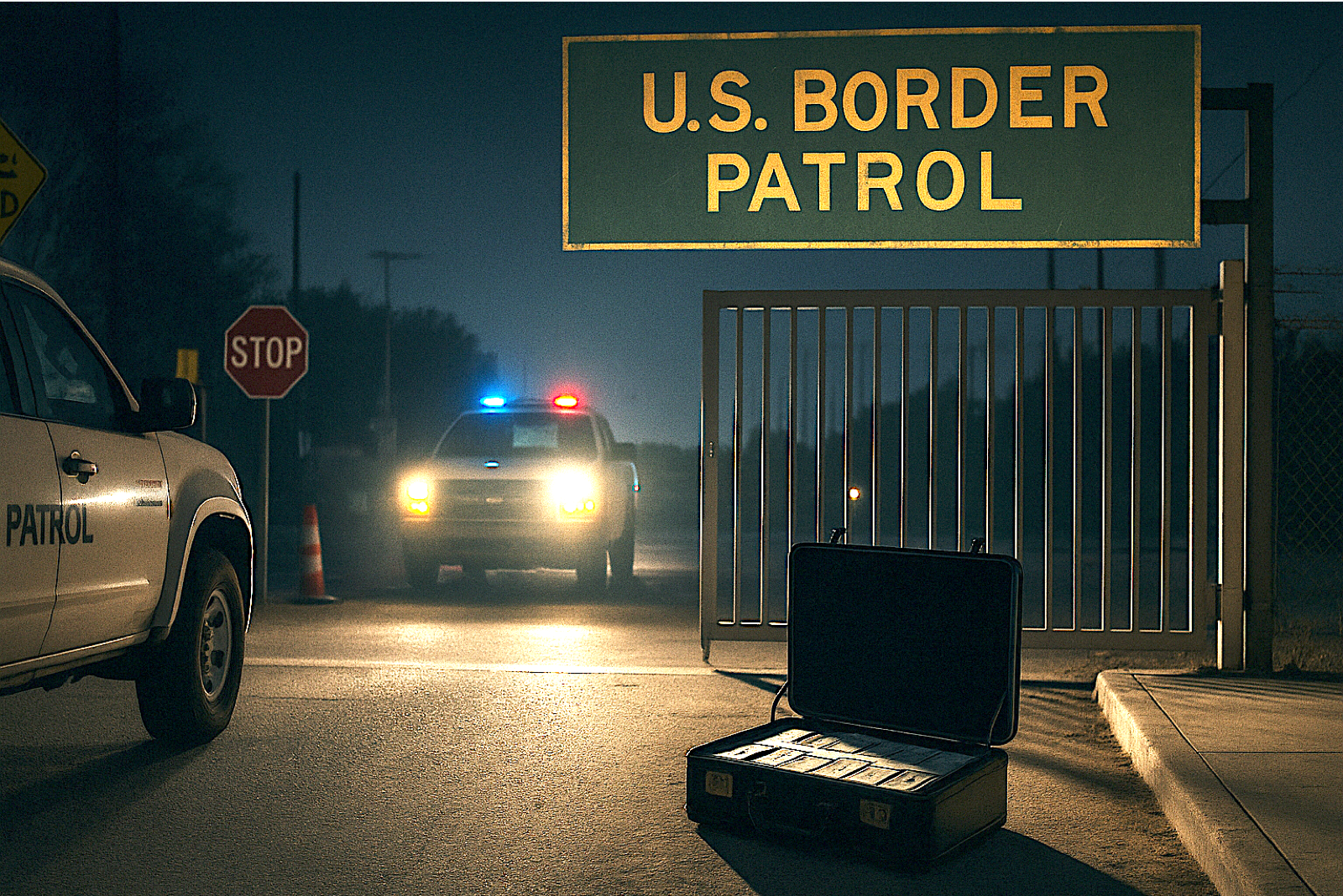
In May 2025, Mexico’s Security Secretary, Omar García Harfuch, confirmed what at first sounded like a bad rumor but turned out to be policy. Seventeen relatives of Sinaloa cartel leaders, including family members of Ovidio Guzmán López, the son of Joaquín “El Chapo” Guzmán—were quietly allowed entry into the United States. Among them, according to El País, was Griselda López Pérez, El Chapo’s former wife and Ovidio’s mother.
This was not gossip from a fringe outlet or a partisan attack line. It was reported by the Associated Press and CBS News, citing Harfuch’s direct confirmation. Mexican officials said the arrangement was part of a “cooperation deal,” in which Ovidio provided intelligence on rival cartels in exchange for leniency for his family.
If accurate, this means that the same administration that built its image on “tough borders” and “zero tolerance” negotiated with the relatives of one of the world’s most violent narcotics empires. The same people whose fentanyl shipments are killing thousands of Americans were rewarded with safe entry and protection. You could call that irony; others might call it betrayal.
While migrant families fleeing violence were separated and detained, cartel families crossed with government escorts. While asylum seekers waited in camps, the bloodline of El Chapo got what amounted to a first-class ticket.
The irony deepens when you remember this was not the first time Washington blurred its moral lines in Mexico. A decade earlier, the “Fast & Furious” gun-running scandal saw U.S. agencies lose track of weapons that later turned up at crime scenes. Cooperation was the justification then, too. Every administration claims that back-channel deals are essential to fighting transnational crime. But the pattern repeats: secrecy first, accountability never.
Foreign policy experts call this “constructive engagement.” In practice, it’s selective blindness. We preach sovereignty while violating it in silence; we denounce corruption while building our own quiet exceptions to the rule of law. And each time we do, we tell the world that justice is negotiable so long as it’s politically convenient.
If this was truly a legitimate intelligence operation, where is the transparency? Which congressional committee authorized it? What safeguards ensured that those admitted were not still entangled in cartel finances? Cooperation can serve justice, but secrecy cannot. What we got was not strategy, but stagecraft.
At its core, the deal exposes the moral rot beneath political theater. A government that sells itself as a bulwark against drugs quietly negotiates with the architects of the drug trade. It reveals “law and order” not as principle, but as performance, a stage act in which compassion is punished and complicity rewarded.
II. The Transnational Crime Web: The System Behind the Headline
Deals like this do not exist in isolation. They rest on a vast transnational structure of profit, leverage, and selective enforcement.
According to the DEA’s 2024 and 2025 National Drug Threat Assessments, the Sinaloa Cartel, led in part by Ovidio and his brothers, collectively known as Los Chapitos, remains the dominant force behind fentanyl production and distribution across the Western Hemisphere. The cartel operates an industrial chain that begins with precursor chemicals from Chinese suppliers, continues through Mexican super-labs, and ends in suburban American neighborhoods where counterfeit pills laced with fentanyl are sold online and through social media.
Economically, fentanyl is the perfect product. A kilogram of precursor powder costing less than $1,000 can yield street doses worth over $1.5 million. Unlike cocaine or heroin, it doesn’t rely on vast plantations or harvest seasons. It can be synthesized anywhere, anytime, by anyone with access to chemistry equipment and corruption. It’s capitalism at its most ruthless efficiency.
In June 2025, the U.S. Treasury’s Office of Foreign Assets Control issued another round of sanctions targeting Los Chapitos and their financial networks, detailing their use of shell companies, freight forwarders, and cryptocurrency exchanges to launder profits. The sanctions described multimillion-dollar flows moving through legitimate banking corridors. Yet even as Treasury was freezing assets and issuing press releases about a “whole-of-government” effort, another branch of that same government was apparently rolling out the welcome mat for the traffickers’ families.
This is not strategy; it is schizophrenia.
Law enforcement is supposed to follow a simple moral arithmetic: punish the guilty, protect the innocent, deter future crimes. But the system has rewritten the equation into something unrecognizable. While the Justice Department files indictments, other agencies quietly undercut them through “cooperation arrangements” that blur accountability.
The result is a geopolitical paradox. Mexico fought a bloody battle to capture Ovidio Guzmán, losing soldiers and civilians in the process. He was extradited to the United States to face justice, only for his family to cross the same border with apparent immunity. To the Mexican public, it looked like betrayal. To Americans who believed the rhetoric of “no deals with cartels,” it looked like proof that the rule of law has become negotiable.
The pattern isn’t new. Every “decapitation” strategy, taking down a cartel leader, creates power vacuums that erupt into violence as factions compete for control. The DEA knows this; so do policymakers. Yet they repeat it, because each arrest makes for a headline and every headline feeds the illusion of progress. The war on drugs has become a war of optics, where victory is measured in press conferences instead of lives saved.
Transnational crime thrives on that ambiguity. The Sinaloa Cartel is not just a drug organization; it is a multinational conglomerate of logistics, finance, and political influence. Every time a government cuts a secret deal, it teaches the cartel that rules are optional and cooperation pays. Intelligence agencies may get a few names; the cartel gets legitimacy and breathing room.
What began as a “war on drugs” decades ago has evolved into a business model built around drugs. The seizures, the arrests, the press conferences, they are part of the same cycle that keeps budgets flowing and institutions relevant. And behind that cycle stands a grim consistency: no matter how many traffickers are caught, demand continues, supply adapts, and the funerals never stop.
III. The Human Cost and Betrayal: Families vs. Families
While cartel relatives got safe passage, American families got funerals.
The Centers for Disease Control and Prevention estimates that nearly 87,000 Americans died from drug overdoses between October 2023 and September 2024. Synthetic opioids, chiefly fentanyl, caused the overwhelming majority. Each number represents a life erased, a family rewritten around grief. Parents keep the bedroom doors closed; friends avoid birthdays because the absence is too loud. Entire towns across Appalachia and the Midwest now measure time by the distance between overdose calls.
The economics of fentanyl make tragedy inevitable. A single counterfeit pill can be pressed for less than fifty cents and sold for twenty dollars. It takes two milligrams, barely visible on a penny, to kill. Dealers cut legitimate painkillers with it because the profit margin is obscene. Families are buried because math won.
Meanwhile, the U.S. government holds press events promising to “crack down on cartels” and “secure the border.” Yet the most lethal substance in modern history continues to move freely, disguised in counterfeit painkillers, sold on social platforms to kids who never wake up. The same government that cannot stop that flow apparently found a way to expedite border entry for the families of the men who profit from it.
In Mexico, the toll is equally harrowing. Regions like Sinaloa, Michoacán, and Guerrero resemble low-grade war zones, their economies trapped between poverty and organized crime. Local journalists are assassinated for naming names. Mothers’ collectives scour riverbeds with shovels and sticks, searching for the bones of their children. The violence is so normalized that silence has become a survival tactic.
Further south, in Venezuela, the killing is political rather than narcotic. United Nations investigators and Human Rights Watch have documented hundreds of extrajudicial executions linked to security forces and armed colectivos loyal to the government. These atrocities have nothing to do with the Sinaloa Cartel, yet the moral pattern rhymes: impunity for the powerful, punishment for the powerless. Whether it is a state deciding which citizens to disappear or a cartel deciding who lives to pay next month’s extortion fee, the outcome is the same—systems of power deciding whose lives count.
To be clear, there is no verified evidence linking the Sinaloa family members admitted under this deal to killings in Venezuela. The comparison lies not in shared culpability but in shared hypocrisy. We condemn repression abroad while practicing selective justice at home. We decry authoritarian secrecy even as we hide our own backroom bargains behind “intelligence cooperation.”
And while the media devotes endless airtime to cartel dramas and Netflix glorifications of “El Chapo,” the real stories, the empty chairs, the closed bedroom doors, barely make a segment. America has turned catastrophe into entertainment. The victims remain footnotes, their pain reduced to background noise between election ads.
Victims everywhere understand the translation. Security for some means suffering for others. The slogans of protection conceal the arithmetic of sacrifice. For every border quietly opened to cartel relatives, another coffin closes on an American teenager, another Mexican mother digs through dirt, another Venezuelan protester vanishes without a trace.
IV. The Verdict: A Nation of Selective Justice
When a country begins to negotiate with the enemies it claims to fight, it stops being a nation of laws and becomes a marketplace of exceptions.
The Trump administration’s brand of “law and order” was never about principle. It was about control, optics, and campaign theater. Family separation was televised; the cartel deal was not. One made for easy outrage, the other for quiet contradiction. Both served power.
Every parent who lost a child to fentanyl deserves an answer. Every taxpayer who funded the spectacle of walls and raids deserves to know who signed the entry papers for cartel families. Every Mexican and Venezuelan family mourning state or cartel violence deserves the truth about what the phrase “border security” really protects.
Justice, if it is to mean anything again, must apply equally to the migrant mother and the cartel matriarch, to the addict and to the executive who profits from addiction. What we have instead is a hierarchy of accountability, where wealth, influence, or intelligence value buys immunity.
Congress should demand a full public accounting of the deal’s terms, vetting, and oversight. The Department of Justice and the Department of Homeland Security must release clear frameworks for any future cooperation with organized crime networks. And the press must stop chasing viral outrage while ignoring the bureaucratic paper trails that define real corruption.
The United States cannot continue to trade transparency for expediency, morality for optics. “Law and order” that negotiates with poison is not justice. It is complicity dressed in uniform. The first step toward redemption is honesty, and the second is equality before the law. Until we have both, every proclamation of toughness at the border will ring hollow over the sound of shovels and sirens.
References
The Deal / Confirmation
Associated Press. “Mexican Security Chief Confirms Cartel Family Members Entered U.S. in a Deal with Trump Administration.” Associated Press News, May 13, 2025. https://apnews.com/article/trump-sinaloa-cartel-ovidio-guzman-harfuch-2025.
El País. “Harfuch Reconoce la Salida de 17 Familiares de Ovidio Guzmán a Estados Unidos.” El País (México), May 13, 2025. https://elpais.com/mexico/2025-05-13/harfuch-reconoce-la-salida-de-17-familiares-de-ovidio-guzman-a-estados-unidos.html.
El País. “Mexico Asks U.S. to Clarify if Ovidio Guzmán’s Mother and 16 Relatives Crossed the Border.” El País (English Edition), May 13, 2025. https://english.elpais.com/international/2025-05-13/mexico-asks-us-to-clarify-if-ovidio-guzmans-mother-and-16-relatives-crossed-the-border.html.
CBS News / Associated Press. “17 Family Members of Notorious Cartel Leader Enter U.S. in Deal with Trump Administration, Mexico Says.” CBS News, May 15, 2025. https://www.cbsnews.com/news/trump-administration-sinaloa-cartel-families-deal-2025/.
Associated Press. “Ovidio Guzmán López Pleads Guilty to Drug Charges in U.S.” Associated Press News, Feb 7, 2025. https://apnews.com/article/ovidio-guzman-lopez-guilty-plea-2025.
Transnational Web / Cartel Infrastructure
U.S. Drug Enforcement Administration. 2024 National Drug Threat Assessment. Washington, DC: DEA, 2024. https://www.dea.gov/documents/2024/2024-national-drug-threat-assessment.
U.S. Drug Enforcement Administration. 2025 National Drug Threat Assessment. Washington, DC: DEA, 2025. https://www.dea.gov/documents/2025/2025-national-drug-threat-assessment.
U.S. Department of the Treasury, Office of Foreign Assets Control (OFAC). “Treasury Sanctions Los Chapitos Network for Fentanyl Trafficking.” Press Release No. 2025-112, June 9, 2025. https://home.treasury.gov/news/press-releases/jy112.
U.S. Department of the Treasury, Office of Foreign Assets Control (OFAC). “Sanctions Actions Targeting the Sinaloa Cartel.” OFAC Sanctions List Updates, 2025. https://home.treasury.gov/policy-issues/financial-sanctions/recent-actions.
U.S. Department of the Treasury. “Treasury Sanctions Cartel de los Soles for Narcotics Trafficking and Corruption in Venezuela.” Press Release No. 2025-187, July 25, 2025. https://home.treasury.gov/news/press-releases/jy187.
Human Cost / Fentanyl and Public Health
Centers for Disease Control and Prevention (CDC). Provisional Drug Overdose Death Counts: United States, 2023 to 2024. National Center for Health Statistics, 2025. https://www.cdc.gov/nchs/nvss/vsrr/drug-overdose-data.htm.
Centers for Disease Control and Prevention (CDC). “U.S. Overdose Deaths Decline Slightly in 2024.” CDC Newsroom Release, May 15, 2025. https://www.cdc.gov/media/releases/2025/p0515-overdose-deaths.html.
Centers for Disease Control and Prevention (CDC). FastStats: Drug Overdose Deaths. Updated June 2025. https://www.cdc.gov/nchs/fastats/drug-overdose.htm.
Venezuela Killings / Human Rights Context
United Nations Human Rights Council. Report of the Independent International Fact-Finding Mission on the Bolivarian Republic of Venezuela. Geneva: UN OHCHR, September 2025. https://www.ohchr.org/en/hr-bodies/hrc/ffmv/report-venezuela.
Human Rights Watch. World Report 2025: Venezuela. New York: Human Rights Watch, 2025. https://www.hrw.org/world-report/2025/country-chapters/venezuela.
Human Rights Watch. “Venezuela: Extrajudicial Killings, Abuses by Security Forces Persist.” Human Rights Watch News, April 2025. https://www.hrw.org/news/2025/04/18/venezuela-extrajudicial-killings-abuses-security-forces-persist.
Reuters. “Mexico Has No Evidence Linking Venezuela’s Maduro to Sinaloa Cartel, President Says.” Reuters, August 8, 2025. https://www.reuters.com/world/americas/mexico-has-no-evidence-linking-maduro-sinaloa-cartel-president-says-2025-08-08/.
Home | My Books| About Paul Zurav | Taking a Closer Look | Privacy Policy | Contact
Copyright: © 2026 CTEK LLC / Paul Zurav