
So When Can i Call you Traitor?
There are words for what has happened to this country. Precise words, with legal definitions and historical precedents. We have avoided them, carefully, for years - dressing the documented record in the softer language of "norms violations" and "unprecedented behavior" and "concerns about democratic backsliding." This piece uses the actual words. Not as accusations. As definitions. Here is what each word means. Here is what the documented record shows. You decide when the line gets crossed.
Paul Zurav
6/29/202610 min read
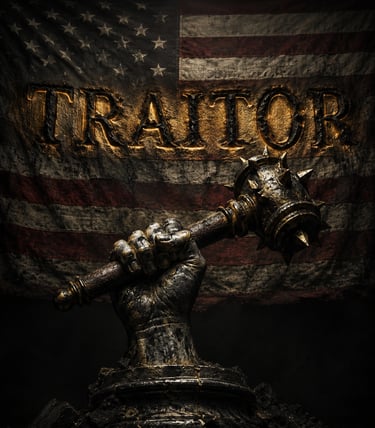
So When Can i Call You Traitor?
Enabler. Insurrectionist. Asset. Coup. The Silencing. Traitor. The words exist. The record exists. What are we waiting for?
By Paul Zurav | June 29, 2026
There are words for what has happened to this country. Precise words, with legal definitions and historical precedents. We have avoided them, carefully, for years - dressing the documented record in the softer language of "norms violations" and "unprecedented behavior" and "concerns about democratic backsliding."
This piece uses the actual words. Not as accusations. As definitions. Here is what each word means. Here is what the documented record shows. You decide when the line gets crossed.
* * *
I. ENABLER
An enabler is someone who allows harmful behavior to continue by declining to stop it when they have the power to do so.
On February 13, 2021, the United States Senate voted 57-43 to convict Donald Trump on a single article of impeachment: incitement of insurrection. 57 senators - a majority - believed he was guilty. The Constitution requires two-thirds, 67 votes. He was acquitted by 10 votes.
Immediately after casting his not-guilty vote, Senate Minority Leader Mitch McConnell stood on the Senate floor and said this: "There is no question - none - that President Trump is practically and morally responsible for provoking the events of the day." He said the people who stormed the Capitol "believed they were acting on the wishes and instructions of their president." He called Trump's conduct a "disgraceful dereliction of duty."
Then he explained his not-guilty vote: jurisdiction. Trump had already left office. The Senate, McConnell argued, could not convict a former president.
What McConnell did not say: he was the one who ensured Trump would be a former president before the trial began. As majority leader in January 2021, McConnell declined Democratic requests to reconvene the Senate early - while Trump was still in office - for an immediate trial. He created the jurisdictional problem he later cited as his reason for acquittal. He built the exit and then used it.
Had 10 more senators voted to convict, the Senate could then have held a separate simple-majority vote to bar Trump from ever holding federal office again. McConnell voted to let him run again. Then he told the world Trump was guilty.
The Republican senators who followed his lead understood what they were doing. So did McConnell. He convicted Trump with his mouth and acquitted him with his hand. Every senator who followed him made the same choice.
THE JUDICIAL COVER: In Trump v. Mazars and Trump v. Deutsche Bank (2020), Chief Justice John Roberts imposed a new, stricter test for congressional subpoenas seeking a president's personal financial records - requiring courts to weigh separation-of-powers concerns before enforcing them. The result was protracted litigation that kept Trump's Deutsche Bank records, tax returns, and financial history out of public view before the 2020 election. The Court also declined to fast-track enforcement. The public voted without the full record. Roberts wrote the opinion.
* * *
II. INSURRECTIONIST
An insurrectionist is someone who incites or participates in a violent uprising against a constituted authority.
On January 6, 2021, a mob attacked the United States Capitol while Congress was in the process of certifying the results of a presidential election. Lawmakers were evacuated. The certification was interrupted. Police officers were beaten. People died.
The Senate Intelligence Committee - led by Republicans - concluded in its bipartisan report that Trump's conduct posed documented threats to the constitutional transfer of power. 57 senators voted that he incited the attack. His own attorney general, his own vice president, his own cabinet members described what happened as an assault on democracy.
Trump has since called the January 6 defendants "hostages" and "patriots." He has described the day as a legitimate protest. He continues to assert the 2020 election was stolen - a claim rejected by more than 60 courts, his own Justice Department, and his own election security officials.
When federal prosecutors finally brought criminal charges related to his efforts to overturn the election, they ran into a wall that had been built specifically to stop them.
THE JUDICIAL COVER: In Trump v. United States, decided July 1, 2024, Chief Justice Roberts wrote the majority opinion establishing that former presidents are absolutely immune from criminal prosecution for core constitutional acts and presumptively immune for other official acts. The ruling instructed lower courts to exclude Trump's interactions with the Justice Department from the criminal case - the same Justice Department he had pressured to declare the election corrupt. The criminal case was effectively ended. Roberts wrote the opinion.
* * *
III. ASSET
An asset, in intelligence terminology, is a person - witting or unwitting - who provides value to a foreign intelligence service.
In August 2020, the Republican-led Senate Select Committee on Intelligence released Volume 5 of its bipartisan report on Russian interference in the 2016 election. The Committee found that the Trump campaign's interactions with Russian intelligence services "posed a grave counterintelligence threat."
Specifically: Trump campaign chairman Paul Manafort shared internal campaign polling data and strategy with Konstantin Kilimnik - whom the Committee assessed was a Russian intelligence officer. The Committee concluded that Russian intelligence likely sought to exploit Manafort to gain insight into the Trump campaign. Roger Stone served as a conduit between the campaign and WikiLeaks for information about upcoming releases of stolen Democratic emails. These are not allegations. These are the findings of a Republican-led Senate committee.
The Mueller Report documented "numerous links" between Trump campaign associates and Russian government individuals. It identified multiple potential episodes of obstruction of justice - the firing of FBI Director James Comey, efforts to curtail the investigation, pressure on witnesses, and an attempt to have White House Counsel Don McGahn create a false record denying Trump had ordered Mueller's removal. Mueller did not reach a traditional prosecutorial judgment because Justice Department policy holds that a sitting president cannot be indicted. He left it to Congress.
Congress did not act.
Deutsche Bank - one of the few major financial institutions willing to lend to Trump after decades of corporate bankruptcies - held more than $300 million in outstanding loans when he took office. In 2017, Deutsche Bank paid $630 million in fines to U.S. and U.K. regulators for a scheme that moved approximately $10 billion out of Russia into offshore accounts. The House Financial Services and Intelligence Committees subpoenaed Deutsche Bank in April 2019 for Trump's financial records. The public never saw them before the election.
THE JUDICIAL COVER: In Trump v. Mazars and Trump v. Deutsche Bank (2020), Chief Justice Roberts' majority remanded the congressional subpoena cases to lower courts under a new, stricter standard - effectively blocking any release of Trump's Deutsche Bank records to Congress before the 2020 election. The Court declined to fast-track enforcement. The subpoenas were still being litigated when Americans voted. Roberts wrote the opinion.
* * *
IV. COUP
A coup is the seizure of power from a constituted government, typically by circumventing or dismantling the legal structures that constrain it.
Coups do not always happen in a single day. The most durable ones are built over years, through legal mechanisms, by people in positions of authority who incrementally dismantle the institutional checks on power while maintaining the appearance of lawful governance.
Consider the architecture that has been built since 2020. The Justice Department was pressured to declare the 2020 election corrupt. The Vice President was pressured to refuse certification. False electors were organized in multiple states. The Capitol was stormed when those efforts failed.
When criminal prosecution was eventually brought, a Supreme Court majority established that a president's official acts cannot form the basis of criminal charges - permanently limiting the accountability available for future presidents who attempt the same. That precedent now belongs to every president who comes after Trump, permanently.
Today's ruling extends the architecture into the regulatory state. The president can now remove the leader of any independent federal agency - the FTC, the FCC, the NLRB, the NRC, the CPSC - at will, for any reason or no reason. The agencies designed to operate free of political pressure, to enforce the law regardless of who holds the White House, now serve at the president's pleasure. No president before Trump attempted to seize this authority. Not one, in 91 years.
Six justices ended that protection today.
THE JUDICIAL COVER: In Trump v. Slaughter, decided June 29, 2026, Chief Justice Roberts wrote the 6-3 majority opinion overturning Humphrey's Executor v. United States - the 1935 precedent that protected independent agencies from political removal. 'Subordinates who exercise the President's power are subject to removal by him,' Roberts wrote. Every regulatory watchdog in the federal government now answers to the president. In 2013, Roberts also wrote the opinion gutting the Voting Rights Act's preclearance formula in Shelby County v. Holder - the mechanism that required jurisdictions with histories of racial discrimination to get federal approval before changing voting laws. Within hours of that ruling, several states moved to enact new restrictions. The dissent warned it would invite discrimination. It did. Four opinions. Thirteen years. The same author. Each one removing a tool that could be used to hold power accountable.
* * *
V. THE SILENCING
When a government cannot silence its critics through argument, it has two options. It can accept the criticism. Or it can make criticism too expensive to continue.
In March 2025, Trump issued an executive order targeting Paul Weiss, one of the largest law firms in the world. The order slammed the firm for its ties to attorneys who had worked on the Mueller investigation and for pro bono work on a lawsuit against the Proud Boys and Oath Keepers - right-wing groups involved in the January 6 attack. The order revoked the firm's security clearances and directed federal agencies to terminate contracts with its clients. Days later, Paul Weiss agreed to provide $40 million in pro bono legal services to causes supported by the Trump administration. The president celebrated publicly. "They're all bending and saying: 'Sir, thank you very much,'" Trump said. "Nobody can believe it."
He was right that it was hard to believe. But it was only the beginning.
Over the following weeks, 8 more major law firms made preemptive deals with the White House to avoid being similarly targeted. Collectively, the 9 firms agreed to provide $940 million in pro bono legal work - nearly $1 billion in legal services - to causes and clients approved by the Trump administration. The White House press secretary called it "bending the knee." Trump said the firms would help "implement his America First agenda." The Heritage Foundation said it expected the firms to assist with projects promoting its view of "election integrity" and regulatory "overreach."
$940 million. Extracted from the legal profession by executive order. Not through legislation. Not through court judgment. Through the credible threat of economic destruction.
The firms that paid were the ones who calculated that $40 million - or $100 million, or $125 million - was cheaper than a fight. The 4 firms that fought instead - Perkins Coie, WilmerHale, Jenner & Block, and Susman Godfrey - won court orders blocking the executive orders as unconstitutional. A federal district judge issued a 102-page opinion excoriating the administration for violating the firms' First Amendment rights, due process, and equal protection. The Justice Department appealed.
Susman Godfrey had been specifically targeted because it helped Dominion Voting Systems obtain a $787.5 million settlement from Fox News for broadcasting false claims about the 2020 election. The firm that proved election lies were lies became a target of the administration built on those lies.
The media received the same treatment, through different instruments. Trump filed a $15 billion lawsuit against the New York Times. A $20 billion suit against the Wall Street Journal. Suits against ABC and Paramount that ended in settlements, with funds directed in part to Trump's presidential library. NPR and PBS had $1.1 billion in federal funding cut while facing simultaneous public attacks on their coverage. First Amendment scholars called the media suits legally baseless under the actual malice standard that has governed defamation law since 1964. The suits proceeded anyway.
A lawsuit you cannot win can still cost the defendant millions to defend. A settlement under threat is still a settlement. Firms that watched Paul Weiss capitulate adjusted their case selection accordingly - quietly, without announcement, without any order ever being issued against them. That is how silencing works when it is done carefully. You do not have to win every case. You only have to make resistance expensive enough that most people choose not to resist.
The legal profession - the institution whose entire purpose is to check the power of government through law - has been systematically pressured, punished, and purchased. The press has been sued into settlement. The watchdog agencies were eliminated this morning.
What is left to resist with?
THE JUDICIAL COVER: The same Court that granted presidential immunity from prosecution and eliminated independent regulatory oversight has not yet ruled on the law firm sanctions or the media suits. But it built the architecture those actions operate within. A president who cannot be criminally prosecuted for official acts, who can fire any regulator who opposes him, who can sanction any lawyer who beats him in court - that president exists because of four opinions written by the same man. The silencing did not require new law. It required only that the old law be removed. Roberts removed it.
* * *
VI. TRAITOR
Under Article III, Section 3 of the United States Constitution, treason consists of levying war against the United States, or adhering to its enemies, giving them aid and comfort. Courts have interpreted this definition narrowly. No one in this piece has been charged with treason under that statute.
But there is another definition - older, broader, and more honest. A traitor is someone who betrays a trust, a country, or a principle to which they owe allegiance.
By that definition, read what you have just read.
A campaign chairman shared internal polling data with a Russian intelligence officer while his candidate ran for president. A president was found practically and morally responsible for an attack on the Capitol by his own party's Senate leader - who then voted to acquit him on a procedural escape he had engineered himself. A series of Supreme Court rulings built a legal architecture in which a president cannot be criminally prosecuted for official acts, congressional subpoenas for financial records can be litigated into irrelevance, every regulatory watchdog answers to the White House, and the lawyers who might fight any of this can be sanctioned out of existence. The press that might cover it can be sued into settlement.
The people who built that architecture are not in prison. They are in power. Some of them are on the Supreme Court.
The Senate had the opportunity to end this in February 2021. 57 senators believed the standard was met. 10 more did not vote their stated beliefs. One man created the procedural escape, used it, and then stood at a microphone and told the country exactly what he had done and why it was wrong. And the country moved on.
We have now arrived at the place that the people who built these guardrails were trying to prevent. The independent agencies are gone. The legal profession has been purchased or punished into compliance. The press is under financial siege. The president is immune from criminal prosecution for official acts. The Senate failed to act when it could. The Court built the walls that made action impossible afterward.
The question this piece began with is the one it ends with:
When does the documented record of betrayal - of constitutional duty, of democratic principle, of the public trust - become something we are willing to name?
The words exist. Enabler. Insurrectionist. Asset. Coup. The Silencing. Traitor. They have definitions. The record has facts. Lawyers will tell you the legal bar has not been met for the most serious of those words. They are probably right.
But the legal bar and the moral bar are not the same bar. And the people who keep pointing to the legal bar are the same people who keep building the architecture that ensures it will never be met.
So I will ask you directly: at what point do you call it what it is?
Because whatever you call it, it is still happening. And the latest piece of it was handed down this morning by the Chief Justice of the United States.
Home | My Books| About Paul Zurav | Taking a Closer Look | Privacy Policy | Contact
Copyright: © 2026 CTEK LLC / Paul Zurav